Artículo original
Vol. 46 Núm. 1 (2026)
19 min
Adiposity and dietary indicators in premenopausal and postmenopausal women attending a breast cancer screening service in Peru
Gabriela ZEA-LINARES1, Carlos BALLON-SALCEDO1,2, Luz LAZO1, Rodrigo DAGA3,4
1 Escuela Profesional de Ciencias de la Nutrición, Universidad Nacional de San Agustín de Arequipa, Arequipa, Perú.
2 Sociedad Científica Estudiantil de Nutrición, Universidad Nacional de San Agustín de Arequipa, Arequipa, Perú.
3 Facultad de Medicina, Universidad Nacional Mayor de San Marcos, Lima, Perú.
4 Centro de Salud Daniel Hernández, Red de Salud Tayacaja, Huancavelica, Perú.
*Correspondencia:
Carlos Ballon-Salcedo carloebs@gmail.com
Recepción:
29/12/2025
Aceptación:
24/03/2026
Publicación:
31/03/2026
Cómo citar
Gabriela ZEA-LINARES, Carlos BALLON-SALCEDO, Luz LAZO, Rodrigo DAGA. Adiposity and dietary indicators in premenopausal and postmenopausal women attending a breast cancer screening service in Peru. Nutr Clín Diet Hosp. 2026; 46(1):521-530 DOI: 10.12873/461ballon
Métricas
263
Visualizaciones
55
Descargas
Compartir
Compartir
Resumen (EN)
Background: Breast cancer is a leading cause of morbidity and mortality in Peru and worldwide. In addition to screening and early detection, lifestyle-related factors such as adiposity and dietary behaviors are relevant in cancer prevention. However, data describing these indicators in Latin American women attending screening services remain limited.
Objective: To compare anthropometric and dietary indicators between premenopausal and postmenopausal Peruvian women attending screening mammography, and to explore their distribution according to mammographic classification.
Materials and Methods: A cross-sectional study was conducted among 99 women attending the League Against Cancer in Arequipa, Peru. Anthropometric and dietary indicators potentially associated with breast cancer risk were assessed using food frequency questionnaires and standardized anthropometric measurements. Comparative and exploratory analyses were performed to examine differences according to menopausal status and to describe patterns of adiposity and lifestyle-related risk indicators.
Results: The median age was 50 years, 40.4% of participants were premenopausal and 59.6% were postmenopausal. Most participants had BI-RADS classifications ≤ 2, limiting exploratory analyses of mammographic findings. A high prevalence of central and total adiposity was observed in the overall sample: 80.8% had a waist circumference ≥ 88 cm, 82.8% had fat mass ≥ 33.8%, and 97.9% had relative fat mass ≥ 33.9%. Most participants reported low intake of red and processed meat, alcohol, and sugary beverages, while added sugar consumption was relatively frequent. Anthropometric and dietary indicators were similar between premenopausal and postmenopausal women.
Conclusion: In this screened population, central and total adiposity were highly prevalent despite relatively low self-reported intake of several selected dietary risk-related items. These findings are descriptive and highlight the need for larger prospective studies with validated instruments to examine how adiposity and lifestyle patterns relate to mammographic findings and breast cancer risk in Latin American women.
Palabras clave (EN):
Breast Neoplasms
Body Composition
Adiposity
Waist-Height Ratio
Risk Factors
Peru (Source: MeSH NLM)
LIST OF ABBREVIATIONS
AICR: American Institute for Cancer Research.
aWC: Abdominal Waist Circumference.
BI-RADS: Breast Imaging Reporting and Data System.
BMI: Body Mass Index.
cWC: Crestal Waist Circumference.
FM: Fat Mass.
IQR: Interquartile Range.
ISAK: International Society for the Advancement of Kinanthropometry.
RFM: Relative Fat Mass.
SD: Standard Deviation.
WC: Waist Circumference.
WHR: Waist-to-Hip Ratio.
WHtR: Waist-to-Height Ratio.
WCRF: World Cancer Research Fund.
INTRODUCTION
Breast cancer is one of the leading causes of cancer-related morbidity and mortality among women in Peru and worldwide1. Early detection through mammographic screening can improve prevention and treatment, while primary prevention strategies include promoting healthy body weight, physical activity, and healthy dietary patterns2,3. In this regard, evidence suggests that adopting a healthy dietary pattern, including plant-based, anti-inflammatory, mediterranean, and other favorable dietary patterns, which include whole grains, nuts, legumes, fruits, vegetables, fish, and dairy products, may help reduce the risk of cancer, especially breast cancer4.
In addition to dietary factors, women are exposed to other non-dietary risk factors, such as the frequent and prolonged use of hormonal contraceptives5 or the omission of annual screenings, despite their importance as a protective measure6. Another relevant factor is the body fatness, particularly the obesity, which has been linked more than 13 types of cancer in woman7,8. Excess body fat is associated with a higher risk of developing between 10 and 26 types of cancer in countries like the United Kingdom and Spain, respectively9,10.
Anthropometric assessment may help characterize adiposity patterns that are relevant to cancer prevention research and can complement the description of dietary and lifestyle-related exposures11. The World Cancer Research Fund/American Institute for Cancer Research (WCRF/AICR) recommends breast cancer prevention through controlling body fatness, physical activity, energy density, and plant-based diets, as well as the consumption of alcoholic drinks and processed meats, among other things12,13.
The association between body fat, diet, and cancer risk highlights the importance of reassessing a healthy lifestyle as a preventive strategy. In this sense, measuring adiposity could be useful for understanding how higher levels of body fat may be associated with an increased risk of cancer development. However, the evidence linking these anthropometric indicators to breast cancer risk factors in Latin American women is limited.
Therefore, the aim of this study was to compare anthropometric and dietary indicators between premenopausal and postmenopausal Peruvian women attending screening mammography, and to explore their distribution according to mammographic classification.
METHODS
A cross-sectional descriptive study was conducted in August 2021 among women aged 18 years or older who attended the mammography unit of the League Against Cancer in Arequipa, Peru. Women were recruited at the time of their routine visit to the service. Pregnant and obese women were excluded. The study was carried out during the COVID-19 pandemic, a context that may have influenced healthcareseeking behavior, lifestyle patterns, and service utilization. The sample size (n=99) was estimated using the number of mammograms performed in 2020 (n=1435), assuming a 95% confidence level, an expected proportion of 22.9%, and a margin of error of 8%.
Information was collected using a structured questionnaire that included sociodemographic characteristics, reproductive history, selected lifestyle factors, and mammographic findings. Menopausal status was classified based on self-report as premenopausal or postmenopausal. Additional variables included age at menarche, parity, age at first birth, history of hormonal contraceptive use, smoking status, physical activity, family history of cancer, and frequency of mammographic screening.
Dietary intake was assessed using a brief 17-item food frequency questionnaire designed to characterize the usual frequency of consumption of selected food groups and behaviors considered relevant in cancer prevention, based on recommendations from the World Cancer Research Fund/American Institute for Cancer Research (WCRF/AICR)3. The questionnaire included items on red meat, processed meat, fried foods, fast foods, sugar-sweetened drinks, sugary foods, fruits, vegetables, legumes, olive oil, and timing of the last meal. This instrument was used to describe self-reported dietary behaviors rather than to quantify nutrient intake or overall diet quality. Mammographic findings were obtained from the clinical record and classified according to the Breast Imaging Reporting and Data System (BI-RADS)14.
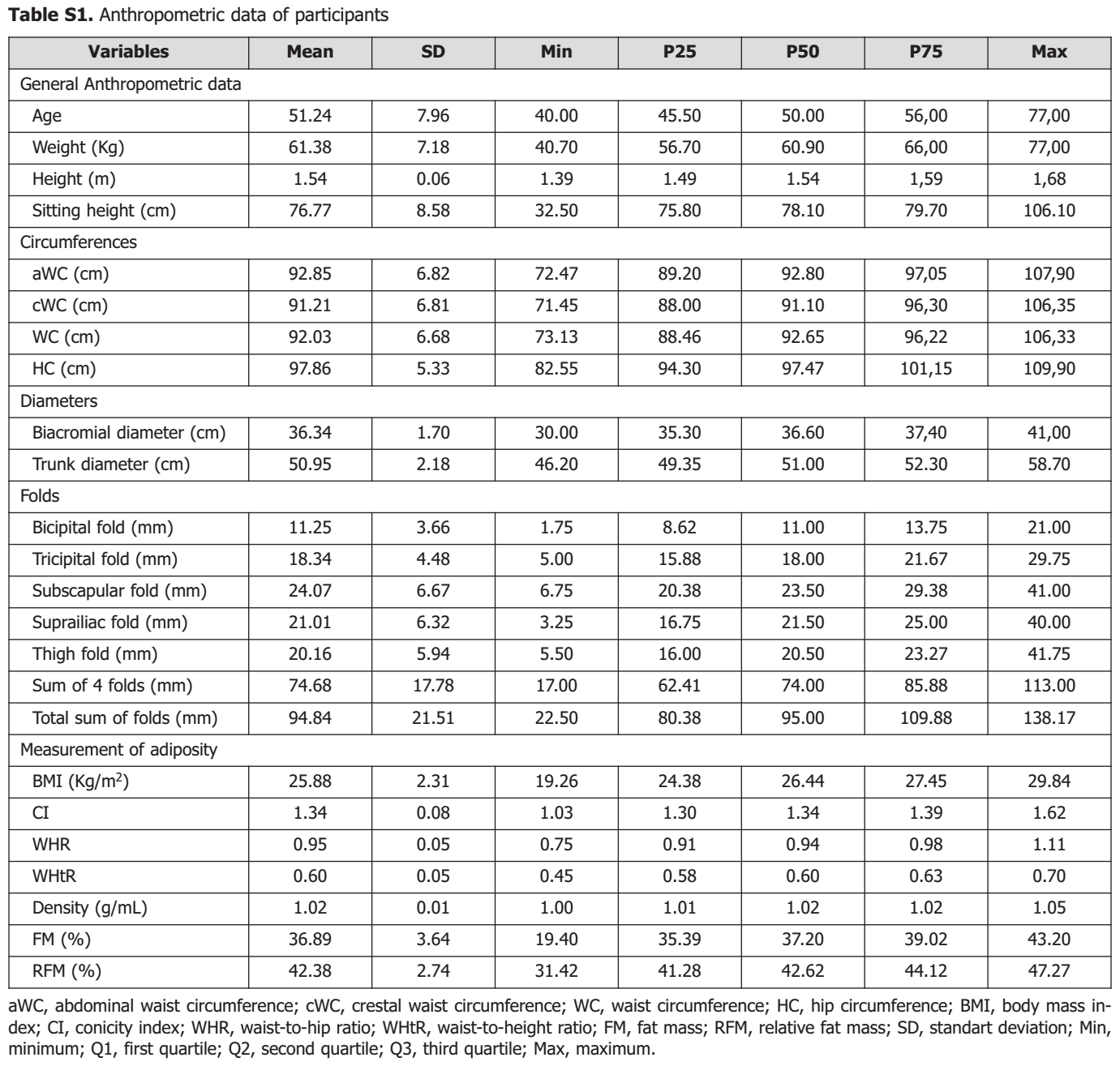
Anthropometric measurements were conducted following standardized protocols of the International Society for the Advancement of Kinanthropometry (ISAK)15. The anthropometrists measured weight, height, circumferences (abdominal, waist, hip), skinfolds (biceps, triceps, subscapular, and suprailiac), and body diameters. From these measurements, Body Mass index (BMI), Waist-to-Hip Ratio (WHR), Waist-toHeight Ratio (WHtR), Conicity Index, Fat Mass (FM), and Relative Fat Mass (RFM) were derived using established equations. Cut-off points, based on previous studies, included WHR ≥ 0.8516, FM and RFM ≥ 33.8%17, Waist Circumference (WC) > 88 cm18. FM was calculated according to Siri et al.19, from body density according to Durnin and Womersley20; this was based on skinfold thicknesses. RFM was calculated following the equation proposed by Woolcott and Bergman21. To minimize measurement bias, calibrated instruments were used (Rosscraft Gaucho Kit, Slim Guide caliper, non-extensible metal tape, OMRON scale). Measurements were replicated three times, with the mean value recorded.
Descriptive statistics were calculated using means and standard deviations or medians and interquartile ranges, depending on data distribution. Categorical variables were summarized using absolute and relative frequencies. All analyses were stratified by menopausal status (premenopausal and postmenopausal). Comparisons between groups were performed using Two sample t-test or Welch’s t-test for continuous variables and Fisher’s exact test for categorical variables. Correlations between anthropometric measurements and body composition indices were also explored to characterize adiposity.
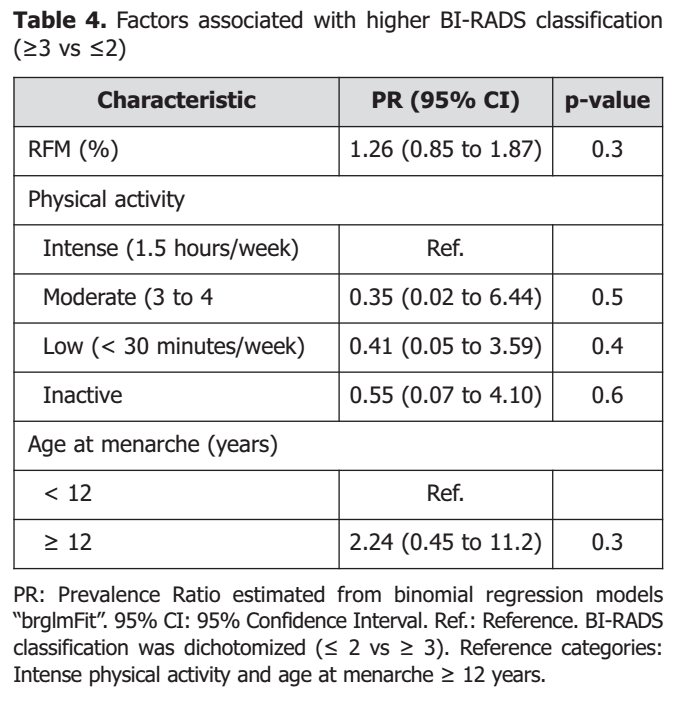
A two-stage analytical approach was applied to identify variables associated with BI-RADS risk classification. In the initial phase, a Random Forest algorithm (comprising 500 trees) was employed to screen candidate variables and assess their relative importance through the mean decrease accuracy and mean decrease Gini metrics. This procedure enabled the selection of variables with elevated discriminative capacity for BI-RADS classification, incorporating RFM, physical activity, and age at menarche.
In the second stage, the selected variables were entered into a binomial regression model (Log-Binomial). A log-link function was employed to directly estimate Prevalence Ratios (PR) and their 95% Confidence Intervals (95% CI), an approach recommended for cross-sectional studies to avoid risk overestimation associated with odds ratios. To address the numerical instability of the log-link function and the reduced effective sample size (n=63), model estimation was performed using Firth’s penalized maximum likelihood method (brglmFit). This methodological approach ensured convergence and minimized bias related to small sample sizes and potential data separation. The results were then summarized using the gtsummary package, with statistical significance set at p < 0.05.
All statistical analyses were conducted using R version 4.0.2 (GNU General Public License)22, employing the randomForest and brglm2 packages.
The study was approved by the Institutional Research Ethics Committee of Clínica Avendaño (Code: 012-2021-CIEI). Written informed consent was obtained from all participants prior to enrollment. Data were collected and processed confidentially and anonymously, in accordance with the principles of the Declaration of Helsinki.
RESULTS
A total of 99 women were included in the study. The median age was 50.0 years (IQR: 45.5 – 56.0), and 40.4% were classified as premenopausal and 59.6% as postmenopausal. As expected, postmenopausal women were older than premenopausal women (median 54.0 vs 44.5 years; p < 0.001). Educational level also differed between groups; postmenopausal women reported a higher frequency of higher education and only primary education or no education (Table 1).
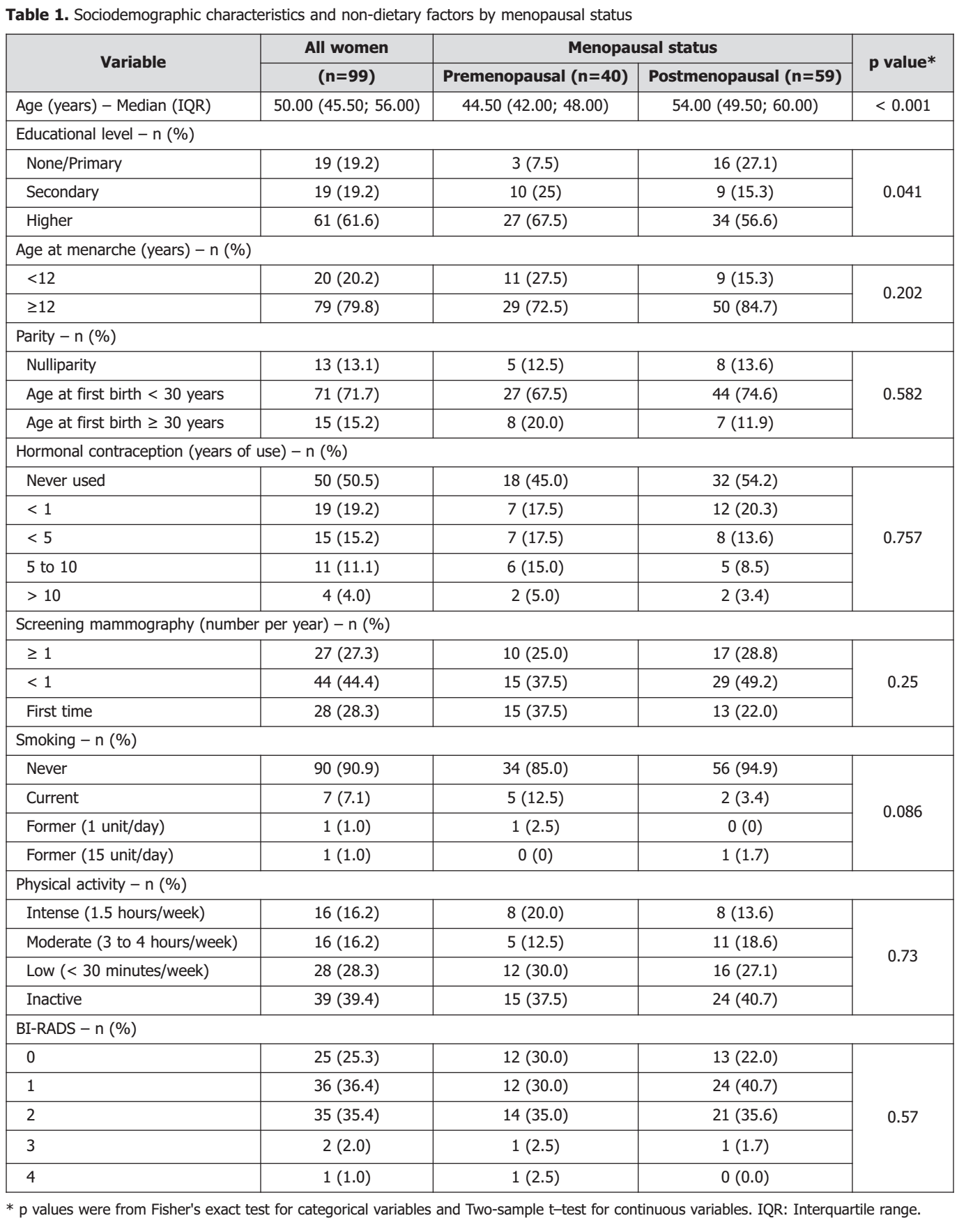
No clear differences were observed between menopausal groups in age at menarche, parity, age at first birth, hormonal contraceptive use, smoking status, screening frequency, or physical activity. In the overall sample, 13.1% were nulliparous, 50.5% had never used hormonal contraceptives, and 39.4% were classified as physically inactive. Most women had mammographic findings classified as BI-RADS 0 to 2, and only three participants were classified as BI-RADS ≥ 3 (Table 1). Only 8 (8.1%) women had a firstto third-degree relative with breast cancer, but 40 (40.4%) of the women had a close relative with cancer in general.
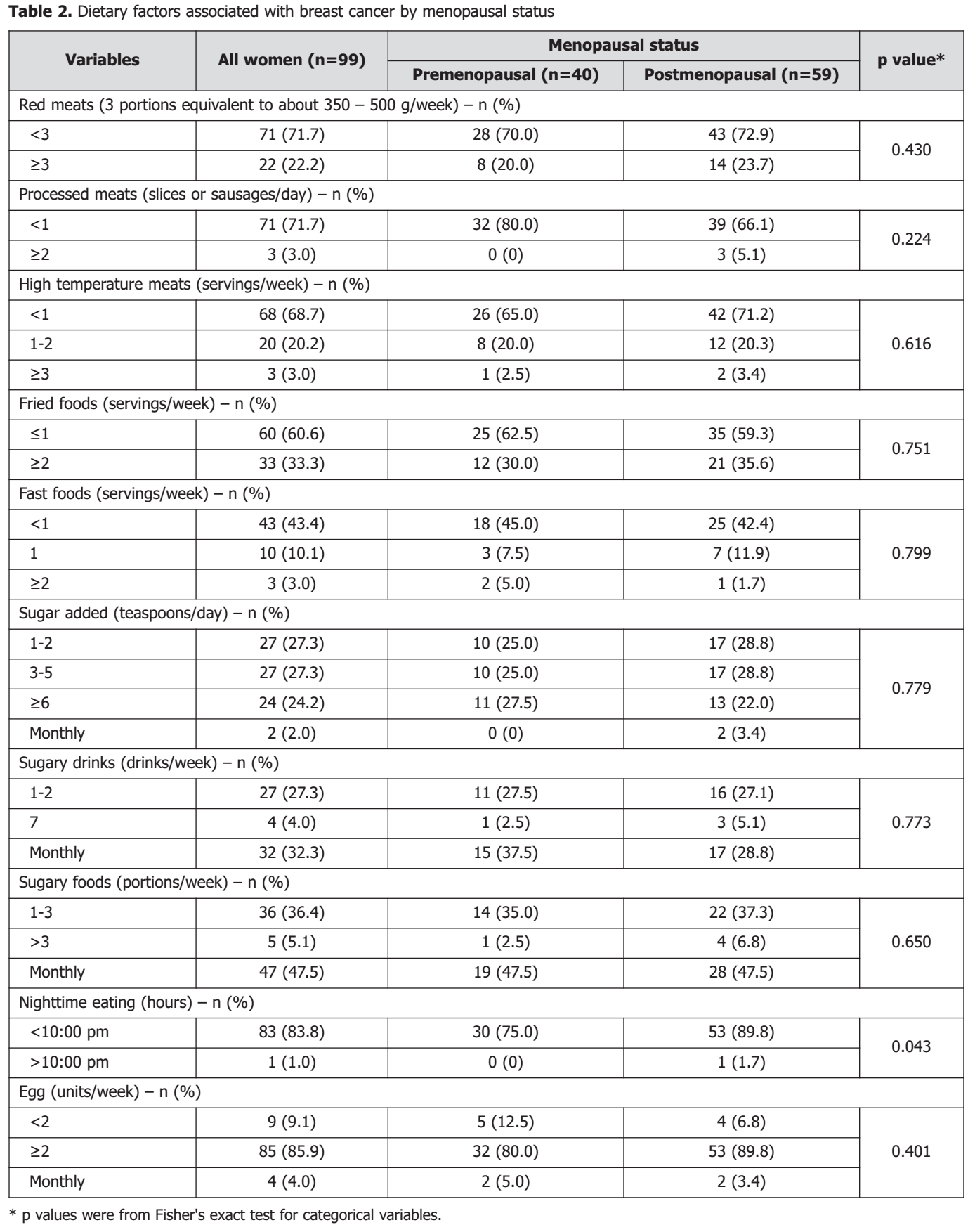
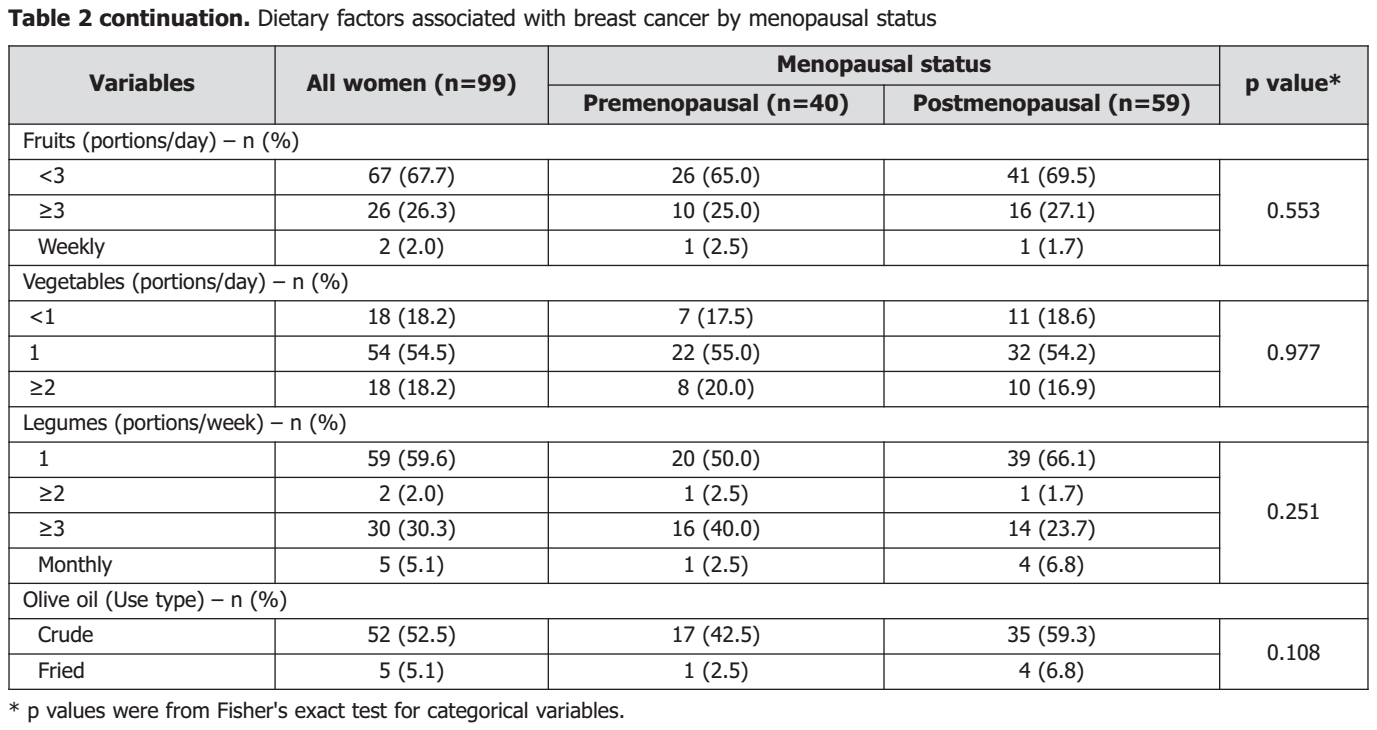
Regarding dietary factors, consumption of foods associated with higher breast cancer risk was generally low and similar between groups. More than 70% of participants reported consuming fewer than three servings of red meat per week and less than one daily serving of processed meat. Frequent consumption of fried foods, fast food, and sugar-sweetened drinks was also low and did not differ between preand postmenopausal women. The only dietary factor that differed between groups was timing of the last meal, with dinner before 22:00 hours being more frequent among postmenopausal women (89.8%) than premenopausal women (75.0%; p=0.043). Intake of fruits, vegetables, legumes, and olive oil was generally moderate, with no significant differences according to menopausal status (Table 2).
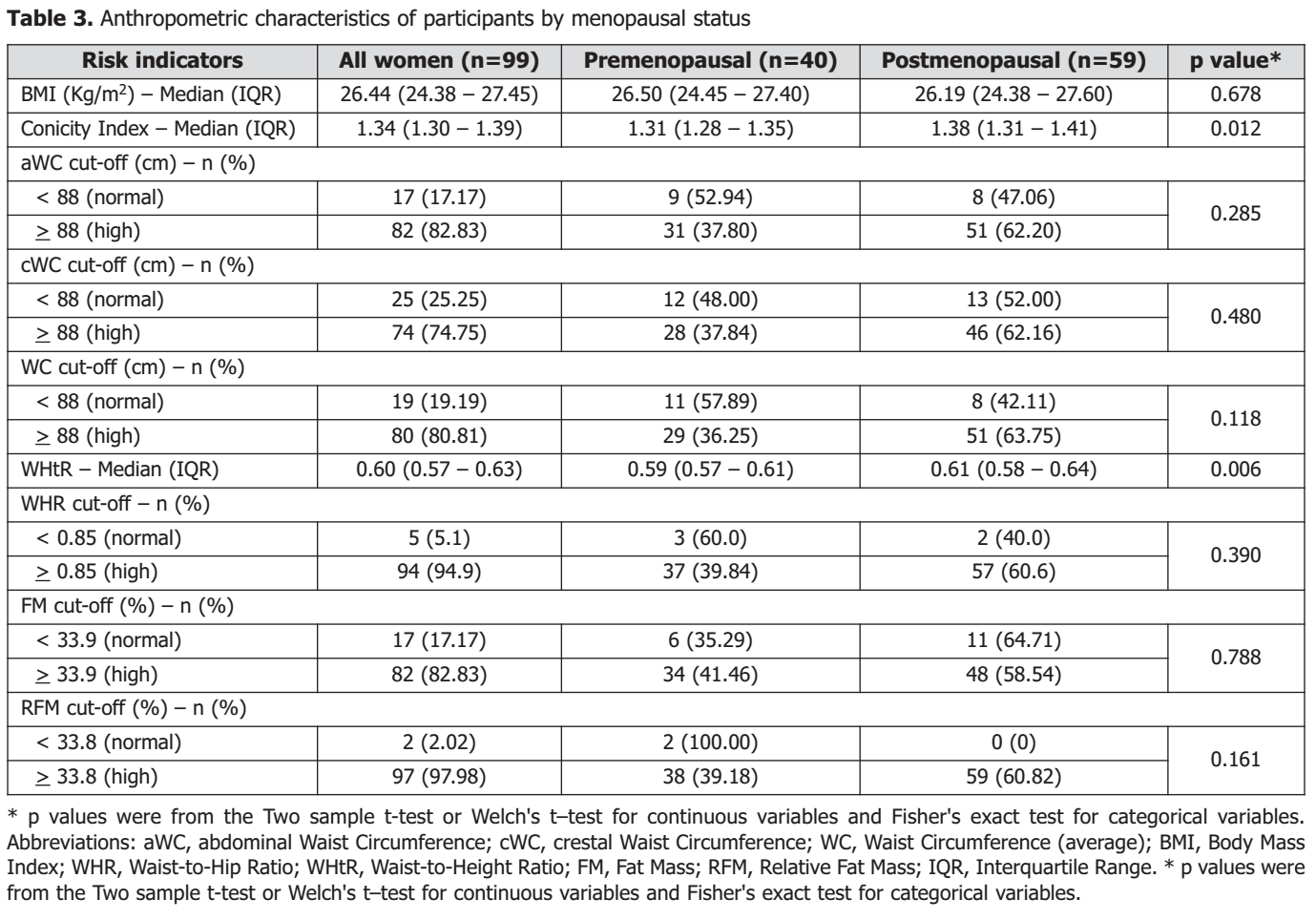
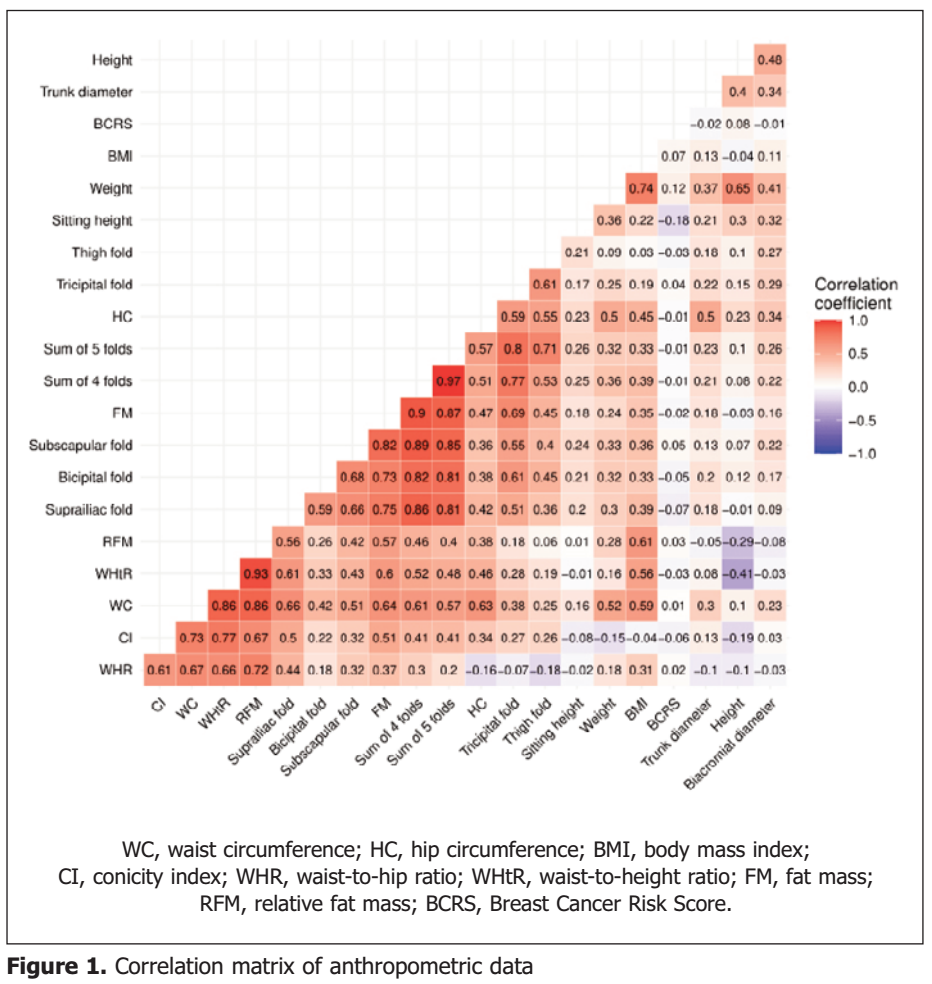
With respect to anthropometric indicators, the median of BMI was 26.4 kg/m² (IQR 24.4 – 27.5), with no differences between groups. A high prevalence of central and total adiposity was observed in the sample. Overall, 80.8% had a WC ≥ 88 cm and 94.9% a WHR ≥ 0.85, with no significant differences by menopausal status. Likewise, 82.8% had FM ≥ 33.9% and 98.0% had RFM ≥ 33.8%. Tricipital skinfold values and other indicators of subcutaneous adiposity were mostly within ranges considered normal, with no differences between groups (Table 3). The variables that demonstrated a Spearman correlation greater than 60 with FM were the suprailiac, subscapular, and biceps skinfold thicknesses, and average WC. Concurrently, RFM demonstrated a correlation only with BMI (Supplementary Figure 1).
Because only three women had BI-RADS classifications ≥ 3, any analysis involving this outcome was severely limited by sparse data. The exploratory analysis using Random Forest identified RFM, physical activity, and age at menarche as the variables with the highest discriminative capacity for BI-RADS classification (≤ 2 vs ≥ 3). Notably, BMI was excluded from the final model in favor of RFM, as the latter provides a more precise estimation of abdominal adiposity and body composition. No statistically significant associations were observed in the adjusted model (Table 4). The RFM showed a PR of 1.26 (95% CI: 0.85–1.87; p = 0.30). Similarly, physical activity levels and age at menarche did not demonstrate consistent or significant associations with the BI-RADS classifications.
DISCUSSION
In this cross-sectional study of women attending a mammography service in southern Peru, we observed a high prevalence of central and total adiposity in both premenopausal and postmenopausal women, together with limited variability in most self-reported dietary indicators. Most participants had mammographic findings classified as BI-RADS 0 to 2, and only a very small number had BI-RADS ≥ 3. These findings suggest that, in this population, excess adiposity coexists with relatively low exposure to several behavioral risk factors, highlighting the importance of contextualizing anthropometric risk within broader lifestyle and reproductive profiles.
Several established non-dietary risk factors for breast cancer include family history, menopausal status, nulliparity, high adiposity, prolonged use of hormonal contraceptives, smoking, high breast density, early age at menarche, and low screening practices9,23. In this screened population, exposure to some of these factors was limited, including smoking and long-term hormonal contraceptive use. Regular mammographic screening remains a key protective strategy, as screening among women older than 40 years has been associated with reductions in breastcancer mortality23. Only 8.1% had a family history of breast cancer, 50.5% never used hormonal contraceptives, 79.8% had menarche after the age of 11 years, and 71.7% had their first child before the age of 30 years. Tobacco exposure is also relevant, given evidence linking long-term smoking to increased breast cancer risk24. Although these exposures were infrequent in this population, they remain relevant for risk stratification in screening contexts.
After menopause, non-modifiable risk factors may interact with modifiable exposures such as adiposity and physical inactivity25. Physical activity has been identified as a protective factor, with regular moderate-to-vigorous activity associated with lower lifetime breast cancer risk independent of adiposity and menopausal status26,27. The persistence of physical inactivity in screened populations is therefore relevant from a prevention perspective, even in the absence of abnormal mammographic findings.
Dietary exposures in this population were broadly consistent with patterns considered compatible with cancer prevention. Alcohol intake was low, and higher levels of consumption have been consistently associated with increased breast cancer risk28. Late-night eating patterns have also been proposed as a behavioral factor related to metabolic dysregulation and cancer risk29, but this pattern was uncommon in the present sample. The available evidence on the relationship between the consumption of animal-based foods and plant-based foods and the development of breast cancer is clearer13, whereas processed meat intake and low consumption of plant-based foods are more consistently associated with increased cancer risk12. Also, cooking meat at high temperatures has been linked to exposure to heterocyclic amines associated with several cancers, including breast cancer30,31. High intake of sugars and high-glycemic foods has also been linked to modest increases in breast cancer risk, with possible variation by menopausal and hormone-receptor status32 and dietary fat quality may further influence this relationship33. Overall, dietary patterns in this screened population did not reflect high exposure to these risk-related dietary factors.
In contrast, anthropometric indicators revealed a consistent pattern of elevated adiposity. Excess body fat has been associated with increased risk of multiple cancers, including postmenopausal breast cancer13. Adiposity has been proposed as a potential contributor through hormonal, inflammatory, and metabolic pathways, and its impact may extend across menopausal stages18. Body-fat percentage thresholds proposed for women suggest that values above approximately one-third of body mass represent excess adiposity21, and higher FM in postmenopausal women has been associated with increased risk of invasive breast cancer17,25. Evidence from European cohorts indicates that multiple adiposity indicators, including BMI, WC, WHR, and FM, are positively associated with postmenopausal breast cancer risk9. Moreover, reliance on BMI alone may underestimate risk in women with central adiposity, and direct or indirect measures of body composition may provide additional information17.
In Latin American populations, evidence regarding adiposity and breast cancer risk before menopause has been heterogeneous. Some studies have suggested inverse associations between general adiposity and premenopausal breast cancer, whereas central adiposity indicators such as WHR have shown positive associations in certain subgroups18. Additional studies in the region have reported inconsistent relationships between anthropometric indicators and breast cancer risk16. These findings highlight the complexity of interpreting adiposity patterns across menopausal stages and underscore the need for region-specific evidence.
This study has several strengths. Anthropometric measurements were obtained by certified anthropometrists following standardized ISAK protocols, with calibrated instruments and replicated measurements, which reduces measurement error and misclassification. The simultaneous assessment of multiple anthropometric indicators and adiposity estimators allowed a comprehensive characterization of body-composition patterns. The study also incorporated dietary and lifestyle variables aligned with international cancer-prevention recommendations13, enabling an integrated assessment of risk-related exposures in a Latin American screening context.
The limitations are important and should be emphasized. First, the cross-sectional design precludes causal inference and does not allow any assessment of breast cancer incidence or prognosis. Second, participants were recruited from a screening service, which may have introduced selection bias and limits generalizability to the broader population of Peruvian women. Third, the sample size was modest and not well suited for robust subgroup analyses or modelling of uncommon mammographic categories. Fourth, the dietary instrument was brief and not formally validated, which increases the likelihood of measurement error and misclassification. Finally, the study was conducted during the COVID-19 pandemic, a context that may have altered diet, physical activity, and healthcare utilization. Dietary intake was assessed using a frequency questionnaire not formally validated in Peruvian populations, and self-reported lifestyle data may be affected by recall and social-desirability bias.
CONCLUSION
In this sample of Peruvian women attending a mammography service, a high prevalence of central and total adiposity was observed across both premenopausal and postmenopausal groups. In contrast, self-reported dietary indicators showed limited variability and did not consistently reflect a clearly favorable or unfavorable pattern. No clear differences were detected between menopausal groups in most anthropometric or dietary indicators. In addition, the very low frequency of BI-RADS ≥ 3 findings precluded meaningful evaluation of associations with mammographic classification. Prospective studies with larger samples, validated dietary instruments, and longitudinal follow-up are needed to clarify the contribution of adiposity and lifestyle patterns to breast cancer risk in Latin American populations and to determine whether these anthropometric indicators predict subsequent changes in mammographic risk or cancer incidence.
REFERENCES
- Bray F, Laversanne M, Sung H, Ferlay J, Siegel RL, Soerjomataram I, et al. Global cancer statistics 2022: GLOBOCAN estimates of incidence and mortality worldwide for 36 cancers in 185 countries. CA: A Cancer Journal for Clinicians. 2024;74(3):229–63. doi:10.3322/caac.21834
- Colditz GA, Bohlke K. Priorities for the primary prevention of breast cancer. CA: A Cancer Journal for Clinicians. 2014 May;64(3): 186–94. doi:10.3322/caac.21225
- World Cancer Research Fund/American Institute for Cancer Research. Diet, nutrition, physical activity and cancer: a global perspective. Continuous Update Project Expert Report 2018. [Internet]. Available from: http://dietandcancerreport.org/
- Bu Y, Qu J, Ji S, Zhou J, Xue M, Qu J, et al. Dietary patterns and breast cancer risk, prognosis, and quality of life: A systematic review. Frontiers in Nutrition. 2023;Volume 9-2022. doi:10.3389/fnut.2022.1057057
- Mørch LS, Skovlund CW, Hannaford PC, Iversen L, Fielding S, Lidegaard Ø. Contemporary Hormonal Contraception and the Risk of Breast Cancer. New England Journal of Medicine. 2017 Dec;377(23):2228–39. doi:10.1056/NEJMoa1700732
- Barke LD, Freivogel ME. Breast Cancer Risk Assessment Models and High-Risk Screening. Radiologic Clinics of North America. 2017 May;55(3):457–74. doi:10.1016/j.rcl.2016.12.013
- Lauby-Secretan Béatrice, Scoccianti Chiara, Loomis Dana, Grosse Yann, Bianchini Franca, Straif Kurt. Body Fatness and Cancer — Viewpoint of the IARC Working Group. New England Journal of Medicine. 375(8):794–8. doi:10.1056/NEJMsr1606602
- Sun M, da Silva M, Bjørge T, Fritz J, Mboya IB, Jerkeman M, et al. Body mass index and risk of over 100 cancer forms and subtypes in 4.1 million individuals in Sweden: the Obesity and Disease Development Sweden (ODDS) pooled cohort study. The Lancet Regional Health – Europe. 2024 Oct 1;45. doi:10.1016/j.lanepe.2024.101034
- Parra-Soto S, Cowley ES, Rezende LFM, Ferreccio C, Mathers JC, Pell JP, et al. Associations of six adiposity-related markers with incidence and mortality from 24 cancers—findings from the UK Biobank prospective cohort study. BMC Med. 2021 Jan 11;19(1): 7. doi:10.1186/s12916-020-01848-8
- Recalde M, Davila-Batista V, Díaz Y, Leitzmann M, Romieu I, Freisling H, et al. Body mass index and waist circumference in relation to the risk of 26 types of cancer: a prospective cohort study of 3.5 million adults in Spain. BMC Med. 2021 Jan 14;19(1):10. doi:10.1186/s12916-020-01877-3
- Bandera EV, Fay SH, Giovannucci E, Leitzmann MF, Marklew R, McTiernan A, et al. The use and interpretation of anthropometric measures in cancer epidemiology: A perspective from the world cancer research fund international continuous update project. International Journal of Cancer. 2016 Dec;139(11):2391–7. doi:10.1002/ijc.30248
- Harris HR, Bergkvist L, Wolk A. Adherence to the World Cancer Research Fund/American Institute for Cancer Research recommendations and breast cancer risk. International Journal of Cancer. 2016 Jun;138(11):2657–64. doi:10.1002/ijc.30015
- World Cancer Research Fund/American Institute for Cancer Research. Dietary and lifestyle patterns and cancer prevention: evidence and recommendations from CUP Global 2025. [Internet]. Available from: https://www.wcrf.org/research-pol-icy/library/dietary-and-lifestyle-patterns-and-cancer-prevention/
- American College of Radiology. BI-RADS Committee. ACR BIRADS breast imaging and reporting data system: breast imaging atlas. 4th ed. Reston, VA: American College of Radiology; 2003. (Breast imaging and reporting data system).
- Esparza F, Vaquero R, Marfell M. Protocolo Internacional para la Valoración Antropométrica. ISAK. 2019.
- Lubián López DM, Butrón Hinojo CA, Castillo Lara M, SánchezPrieto M, Sánchez-Borrego R, Mendoza Ladrón de Guevara N, et al. Relationship of breast volume, obesity and central obesity with different prognostic factors of breast cancer. Scientific Reports. 2021 Dec;11(1):1872–1872. doi:10.1038/s41598-021-81436-9
- Iyengar NM, Arthur R, Manson JE, Chlebowski RT, Kroenke CH, Peterson L, et al. Association of Body Fat and Risk of Breast Cancer in Postmenopausal Women with Normal Body Mass Index: A Secondary Analysis of a Randomized Clinical Trial and Observational Study. JAMA Oncology. 2019 Feb;5(2):155–63. doi:10.1001/jamaoncol.2018.5327
- His M, Biessy C, Torres-Mejía G, Ángeles-Llerenas A, AlvaradoCabrero I, Sánchez GI, et al. Anthropometry, body shape in earlylife and risk of premenopausal breast cancer among Latin American women: results from the PRECAMA study. Scientific Reports. 2020 Dec;10(1):2294–2294. doi:10.1038/s41598-020-59056-6
- Siri WE. Body composition from fluid spaces and density: Analysis of methods. Berkeley: University of California; 1956. 40 p.
- Durnin JVGA, Womersley J. Body fat assessed from total body density and its estimation from skinfold thickness: measurements on 481 men and women aged from 16 to 72 Years. British Journal of Nutrition. 1974 Jul;32(01):77–97. doi:10.1079/bjn19740060
- Woolcott OO, Bergman RN. Relative fat mass (RFM) as a new estimator of whole-body fat percentage – A cross-sectional study in American adult individuals. Scientific Reports. 2018 Dec;8(1): 10980–10980. doi:10.1038/s41598-018-29362-1
- R Core Team. R: A Language and Environment for Statistical Computing [Internet]. Vienna, Austria: R Foundation for Statistical Computing; 2024. Available from: https://www.R-project.org/
- Myers ER, Moorman P, Gierisch JM, Havrilesky LJ, Grimm LJ, Ghate S, et al. Benefits and harms of breast cancer screening: A systematic review. JAMA - Journal of the American Medical Association. 2015 Oct;314(15):1615–34. doi:10.1001/jama.2015.13183
- Wang K, Li F, Zhang X, Li Z, Li H. Smoking increases risks of allcause and breast cancer specific mortality in breast cancer individuals: a dose-response meta-analysis of prospective cohort studies involving 39725 breast cancer cases. Oncotarget. 2016 Dec;7(50):83134–47. doi:10.18632/oncotarget.13366
- Sprague BL, Trentham-Dietz A, Egan KM, Titus-Ernstoff L, Hampton JM, Newcomb PA. Proportion of invasive breast cancer attributable to risk factors modifiable after menopause. American journal of epidemiology. 2008 Aug;168(4):404–11. doi:10.1093/aje/kwn143
- Pizot C, Boniol M, Mullie P, Koechlin A, Boniol M, Boyle P, et al. Physical activity, hormone replacement therapy and breast cancer risk: A meta-analysis of prospective studies. European Journal of Cancer. 2016 Jan;52:138–54. doi:10.1016/j.ejca.2015.10.063
- Godinho-Mota JCM, Gonçalves LV, Soares LR, Mota JF, Martins KA, Freitas-Junior I, et al. Abdominal Adiposity and Physical Inactivity Are Positively Associated with Breast Cancer: A Case-Control Study. BioMed Research International. 2018 Jul;2018:1–7. doi:10.1155/2018/4783710
- McDonald JA, Goyal A, Terry MB. Alcohol intake and breast cancer risk: Weighing the overall evidence. Current Breast Cancer Reports. 2013 Sep;5(3):208–21. doi:10.1007/s12609-013-0114-z
- Li M, Tse LA, Chan W cheong, Kwok C hei, Leung S lan, Wu C, et al. Nighttime eating and breast cancer among Chinese women in Hong Kong. Breast Cancer Research. 2017 Dec;19(1):31–31. doi:10.1186/s13058-017-0821-x
- Zheng W, Lee SA. Well-Done Meat Intake, Heterocyclic Amine Exposure, and Cancer Risk. Nutrition and Cancer. 2009 Jul;61(4): 437–46. doi:10.1080/01635580802710741
- Pala V, Krogh V, Berrino F, Sieri S, Grioni S, Tjønneland A, et al. Meat, eggs, dairy products, and risk of breast cancer in the European Prospective Investigation into Cancer and Nutrition (EPIC) cohort. The American Journal of Clinical Nutrition. 2009 Sep;90(3):602–12. doi:10.3945/ajcn.2008.27173
- Mullie P, Koechlin A, Boniol M, Autier P, Boyle P. Relation between Breast Cancer and High Glycemic Index or Glycemic Load: A Meta-analysis of Prospective Cohort Studies. Critical Reviews in Food Science and Nutrition. 2016 Jan;56(1):152–9. doi:10.1080/10408398.2012.718723
- Mayne ST, Playdon MC, Rock CL. Diet, nutrition, and cancer: past, present and future. Nature Reviews Clinical Oncology. 2016 Aug;13(8):504–15. doi:10.1038/nrclinonc.2016.24
Explorar
Artículos
Volúmenes
Sobre la revista
Más leídos
Consumo de bebidas energizantes y efectos adversos en la salud de estudiantes universitarios
Nutrición Clínica y Dietética Hospitalaria
Uso de redes sociales y riesgo de trastornos de conducta alimentaria en adolescentes mujeres de un colegio en Lima, Perú
Nutrición Clínica y Dietética Hospitalaria
Consumo de bebidas energizantes en estudiantes universitarios y sus factores asociados.
Nutrición Clínica y Dietética Hospitalaria
Microbiota intestinal y eje intestino-cerebro: una revisión de su interacción con el sistema nervioso central
Nutrición Clínica y Dietética Hospitalaria
Factores asociados a la diabetes mellitus tipo 2 de la población adulta peruana.
Nutrición Clínica y Dietética Hospitalaria