Artículo original
Vol. 46 Núm. 1 (2026)
15 min
Phase angle quartiles and all-cause mortality in older adults: a longitudinal cohort study
Phase Angle Quartiles and All-Cause Mortality in Older Adults: A Longitudinal Cohort Study.
Walter SEPÚLVEDA-LOYOLA1, Mario MOLARI2, Cristian BARROS-OSORIO1, Yeny CONCHA-CISTERNAS3, Vanessa SUZIANE PROBST4
1 Faculty of Health and Social Sciences, Universidad de Las Americas, Santiago.
2 Postgraduate Program in Physical Education, State University of Londrina, Londrina.
3 Universidad Santo Tomás, Talca, Chile.
4 Center for Research and Postgraduate Studies in Health (CEPPOS), Center for Health Sciences (CCS), State University of Londrina (UEL), Londrina, Paraná, Brazil.
*Correspondencia:
Walter Sepúlveda-Loyola wsepulveda@udla.cl
Recepción:
11/01/2026
Aceptación:
28/02/2026
Publicación:
04/03/2026
Cómo citar
Walter SEPÚLVEDA-LOYOLA, Mario MOLARI, Cristian BARROS-OSORIO, Yeny CONCHA-CISTERNAS, Vanessa SUZIANE PROBST. Phase angle quartiles and all-cause mortality in older adults: a longitudinal cohort study. Nutr Clín Diet Hosp. 2026; 46(1):349-355 DOI: 10.12873/461wsepulveda
Métricas
352
Visualizaciones
83
Descargas
Compartir
Compartir
Resumen (EN)
Introduction: Phase angle (PhA) derived from bioelectrical impedance analysis (BIA) is a non-invasive biomarker that reflects cell membrane integrity and nutritional status. Although several cut-off points have been proposed to identify high-risk individuals, the relationship between PhA quartiles and mortality risk has not been systematically explored.
Objective: This study aimed to evaluate the association between quartiles of PhA and all-cause mortality in older adults.
Methods: In this prospective cohort study, PhA was measured at baseline using standardized BIA procedures, and participants were stratified into quartiles (Q1–Q4) according to the distribution of PhA values. The quartiles were defined based on the internal distribution of the sample. Mortality and follow-up time were recorded. Cox proportional hazards models were applied to estimate hazard ratios (HRs) and 95% confidence intervals (CIs) for each quartile, using Q1 as reference. Model 1 was unadjusted, Model 2 adjusted for age and sex, and Model 3 further adjusted for the Charlson Comorbidity Index.
Results: A total of 398 older adults were analyzed, among whom 50 deaths occurred during the seven-year follow-up period. Participants in higher PhA quartiles had lower comorbidity scores and improved survival. In the fully adjusted model, HRs (95% CI) for Q2, Q3, and Q4 versus Q1 were 0.48 (0.24–0.95), 0.43 (0.20–0.91), and 0.27 (0.11–0.67), respectively (p-trend = 0.002). Each increment in PhA quartile corresponded to a substantial reduction in mortality risk, indicating a robust dose-response relationship independent of age, sex, and multimorbidity.
Conclusions: Quartile-based analysis revealed a graded, inverse relationship between PhA and mortality. Higher PhA values independently predicted greater survival, supporting its use as an accessible biomarker for risk stratification and early intervention in geriatric care.
Palabras clave (EN):
Electric Impedance
nutritional biomarkers
survival Analysis
comorbidity
prospective cohort
geriatric risk stratification
INTRODUCTION
Phase angle (PhA), derived from bioelectrical impedance analysis (BIA), is a non-invasive marker of cellular health and membrane integrity that reflects the balance between intracellular and extracellular water compartments1. Lower PhA values indicate impaired cell membrane function, reduced body cell mass, and malnutrition, which are conditions frequently associated with frailty, sarcopenia, and increased mortality risk2–6. Over the past decade, PhA has gained considerable attention as a prognostic biomarker across diverse clinical settings, including oncology, nephrology, chronic respiratory disease, and geriatric populations6–9.
Several studies have proposed specific PhA cut-off points to identify individuals at higher risk of adverse outcomes10–13. However, these thresholds have been highly variable, ranging from ≤ 4.5° to ≤ 6.0°, depending on age, sex, ethnicity, and underlying disease10–13. This heterogeneity complicates clinical interpretation and limits the development of universal reference standards. Moreover, most prior investigations have used dichotomous or arbitrary PhA values to predict mortality, without exploring how the risk may vary across quartiles of PhA distribution10,11,13. Such an approach could provide a more granular understanding of how incremental increases in PhA confer differential protection against mortality.
Emerging evidence suggests that higher PhA values are associated with lower all-cause mortality13–15. In a large population-based study using data from NHANES, Xia et al. (2025) found that adults with higher PhA (≥ 6.96°) had significantly lower mortality risk (HR 0.73; 95 % CI 0.59–0.91)14. Similarly, a recent analysis in older adults with hip fracture showed that PhA was an independent predictor of one-year survival16. Despite these advances, no studies to date have examined quartilebased PhA analyses to determine whether intermediate or higher quartiles exert a graded or protective effect on mortality risk after adjusting for comorbidities and age-related factors.
Therefore, the present study aimed to evaluate the association between quartiles of PhA and all-cause mortality in older adults. By stratifying mortality risk according to PhA quartiles, this work seeks to identify meaningful prognostic thresholds that may improve the clinical utility of PhA as a biomarker for risk stratification and survival prediction in aging populations.
METHODS
Study Design
This was an observational, analytical, longitudinal epidemiological study. Baseline data were collected between 2009 and 2010, and mortality outcomes were ascertained over a sevenyear follow-up period (2009–2016). Both study phases were approved by the Research Ethics Committee of Universidade Norte do Paraná (protocols PP/0070/09 and PP1168693). The study is part of the Study on Longevity and Aging (EELO) project, conducted in the municipality of Londrina, Paraná, Brazil, and developed by Universidade Norte do Paraná (UNOPAR). The study was reported in accordance with the Strengthening the Reporting of Observational Studies in Epidemiology (STROBE) guidelines for observational research17.
Population and Sample
The target population consisted of 43,610 older adults residing in the urban area of Londrina in 2009. A representative sample of 414 individuals was calculated based on a 5% sampling error. To account for potential losses, an additional 20% was added, resulting in an initial target sample of 518 participants. After applying eligibility criteria, the final analytical sample comprised 419 older adults, as 97 individuals were excluded.
Participants were recruited between 2009 and 2010 from the registries of all 38 Basic Health Units (UBSs) located in the urban area of the municipality. A stratified random sampling strategy was used according to the proportional distribution of older adults across geographic regions (15% central, 27% north, 23% south, 19% east, and 16% west).
Inclusion criteria were: age ≥60 years; physical independence (levels 3 or 4 on the Spirduso Functional Status Scale)18; preserved cognitive function (>17 points on the Mini-Mental State Examination)19; and residence in the urban community of Londrina, Paraná. Individuals with severe respiratory, neurological, or musculoskeletal impairments (including amputations or prostheses) were excluded.
Phase Angle
Phase angle was assessed using bioelectrical impedance analysis (Biodynamics 310™, Biodynamics Corp., USA) following a minimum 10-hour fasting period. Participants were instructed to void their bladder prior to the assessment. Measurements were performed on the dominant side of the body, with participants in the supine position and the arms and legs positioned approximately 30 degrees from the body midline. Electrode placement sites were cleaned with alcohol prior to electrode application. One electrode was placed on the hand and another on the foot, according to standardized manufacturer recommendations.
Comorbidities
Comorbidity burden was assessed using the Charlson Comorbidity Index (CCI), a validated instrument that incorporates 19 predefined medical conditions. The index was calculated according to the original weighting algorithm proposed by Charlson et al.20, providing a standardized measure of comorbidity severity for each participant.
Mortality
The mortality data and causes of death for the period from 2009 to 2016 were obtained from the Municipal Health Department of Londrina, with information sourced from the national computerized system of the Information and Mortality Nucleus.
Statistical Analysis
Continuous variables were presented as the mean and standard deviation (SD) and categorical variables are presented as the number and percentage. The parametric distribution of the continuous variables was checked using the Kolmogorov Smirnov test. Phase Angle was categorized into quartiles based on its distribution in the study population. Quartile cut-off points were determined using the 25th, 50th, and 75th percentiles of Phase Angle values. Participants were then classified into four groups according to these thresholds, with the lowest quartile (Q1) representing the lowest Phase Angle values and serving as the reference category in subsequent analyses. Specifically, quartiles were defined as follows: Q1 ≤ 5.68°, Q2 5.69–6.18°, Q3 6.19–6.66°, and Q4 ≥ 6.67°. Cut-off values were rounded to two decimal places as a pragmatic decision to improve readability and clinical communication, without altering the underlying percentile-based categorization, the distribution of participants across quartiles, or the statistical modeling. This rounding was applied solely for presentation purposes and did not influence the observed dose–response relationship between phase angle and mortality.
We performed a time-to-event analysis using the Cox proportional hazards model to assess the relationship between Phase Angle and all-cause mortality. Follow-up time was defined as the number of days from baseline to death or censoring. Phase Angle was analyzed in quartiles, with Q1 as reference. Three models were constructed: Model 1 (unadjusted), Model 2 (adjusted for age and sex), and Model 3 (further adjusted for multimorbidity index). Covariates included age (years), gender (1=men, 0=women), and Charlson Comorbidity Index (score). Hazard ratios (HRs) with 95% confidence intervals (CIs) and two-sided p-values were reported. A linear trend test across quartiles was computed using the median Phase Angle per quartile. The proportional hazards assumption was evaluated using Schoenfeld residuals, and no evidence of violation was observed for the fitted models. All analyses were conducted using the Cox PH regression function (statsmodels PHReg, Breslow ties). All statistical analyses were performed using Python (version 3.10). Data management and analyses were conducted using standard scientific libraries, including pandas, NumPy, SciPy, and lifelines for survival analyses. Statistical significance was set at p < 0.05.
RESULTS
Characteristics
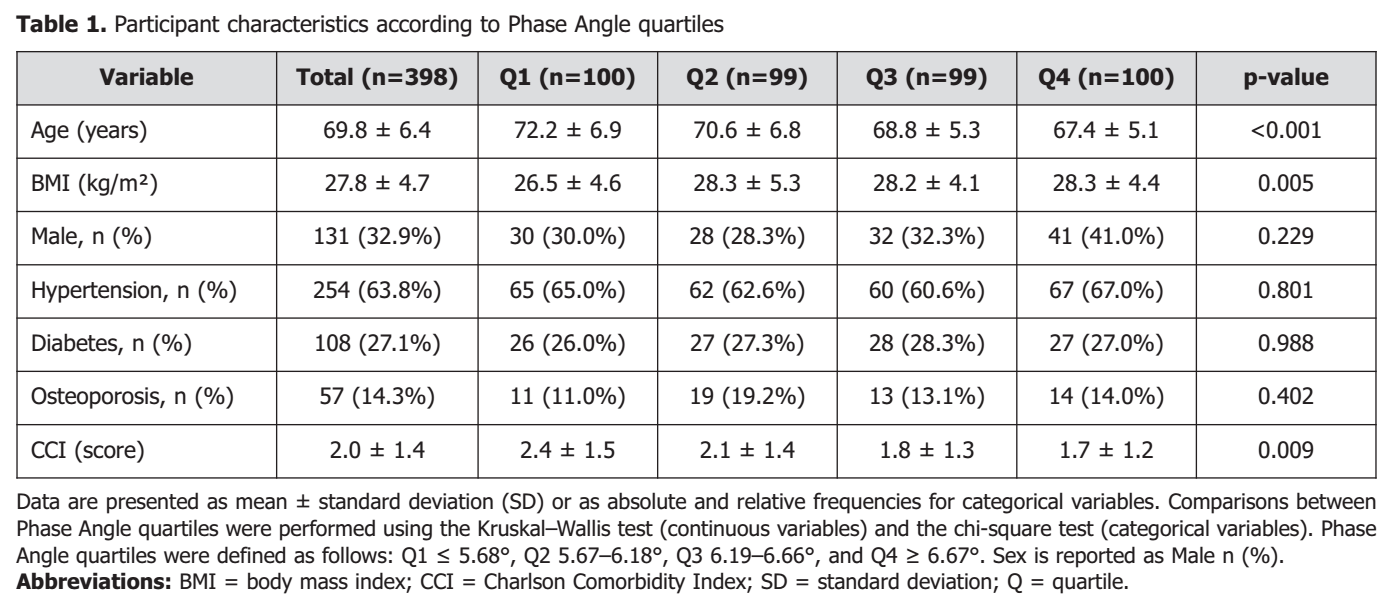
A total of 398 participants were included in the analysis, during the seven-year follow-up period, a total of 50 deaths were recorded. Mean age was 69.8 ± 6.4 years, and 32.9% were men. Across increasing quartiles of Phase Angle, participants tended to be younger and have a lower Charlson Comorbidity Index. The mean Charlson Index decreased progressively from 2.4 ± 1.5 in Q1 to 1.7 ± 1.2 in Q4 (p = 0.009).
Risk of Mortality of each Phase Angle Quartile
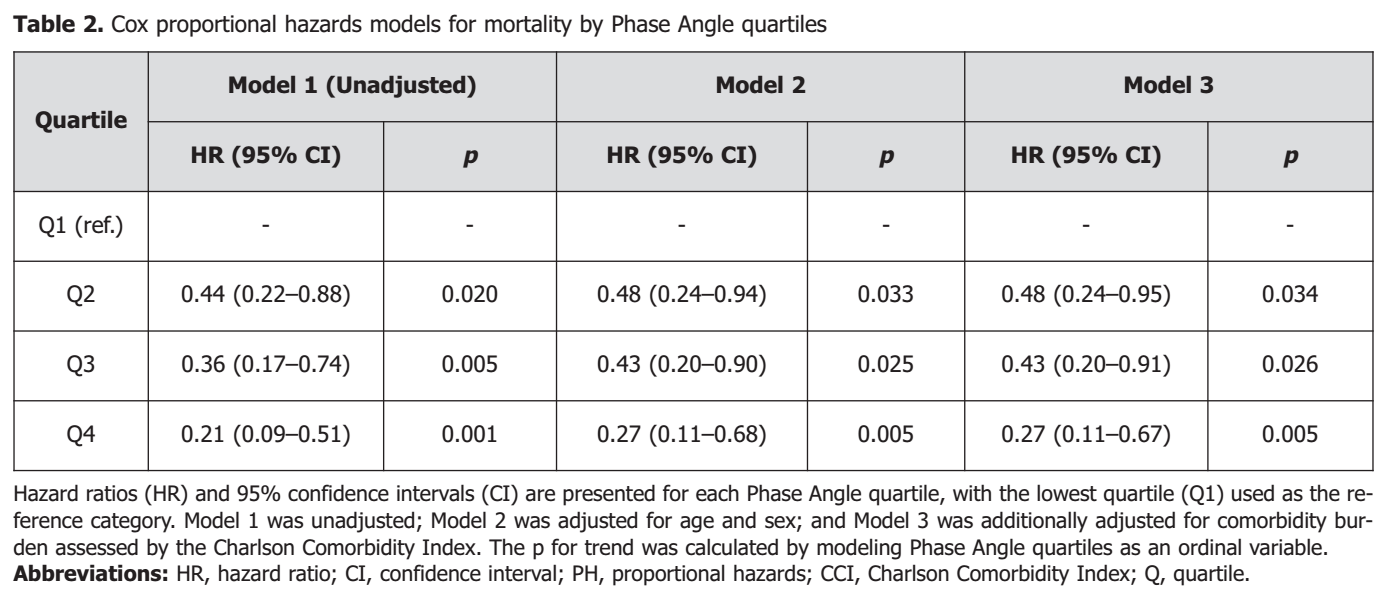
The Cox proportional hazards analysis was conducted using mortality as the outcome and Phase Angle as the main exposure variable categorized in quartiles (Q1–Q4). Q1 represented the reference group (lowest Phase Angle). Three models were tested: Model 1 (unadjusted), Model 2 (adjusted for age and sex), and Model 3 (adjusted for age, sex, and Charlson Comorbidity Index). Hazard ratios (HR) and 95% confidence intervals (CI) were estimated for each quartile, along with a p-value for trend across quartiles.
Higher Phase Angle values were associated with lower hazard of mortality across quartiles. In the fully adjusted model (Model 3), hazard ratios (95% CI) were 0.48 (0.24–0.95) for Q2, 0.43 (0.20–0.91) for Q3, and 0.27 (0.11–0.67) for Q4, compared with Q1 (p for trend = 0.002). This indicates a robust inverse and graded association between Phase Angle and mortality risk.
Kaplan–Meier survival analysis of each Phase Angle Quartile
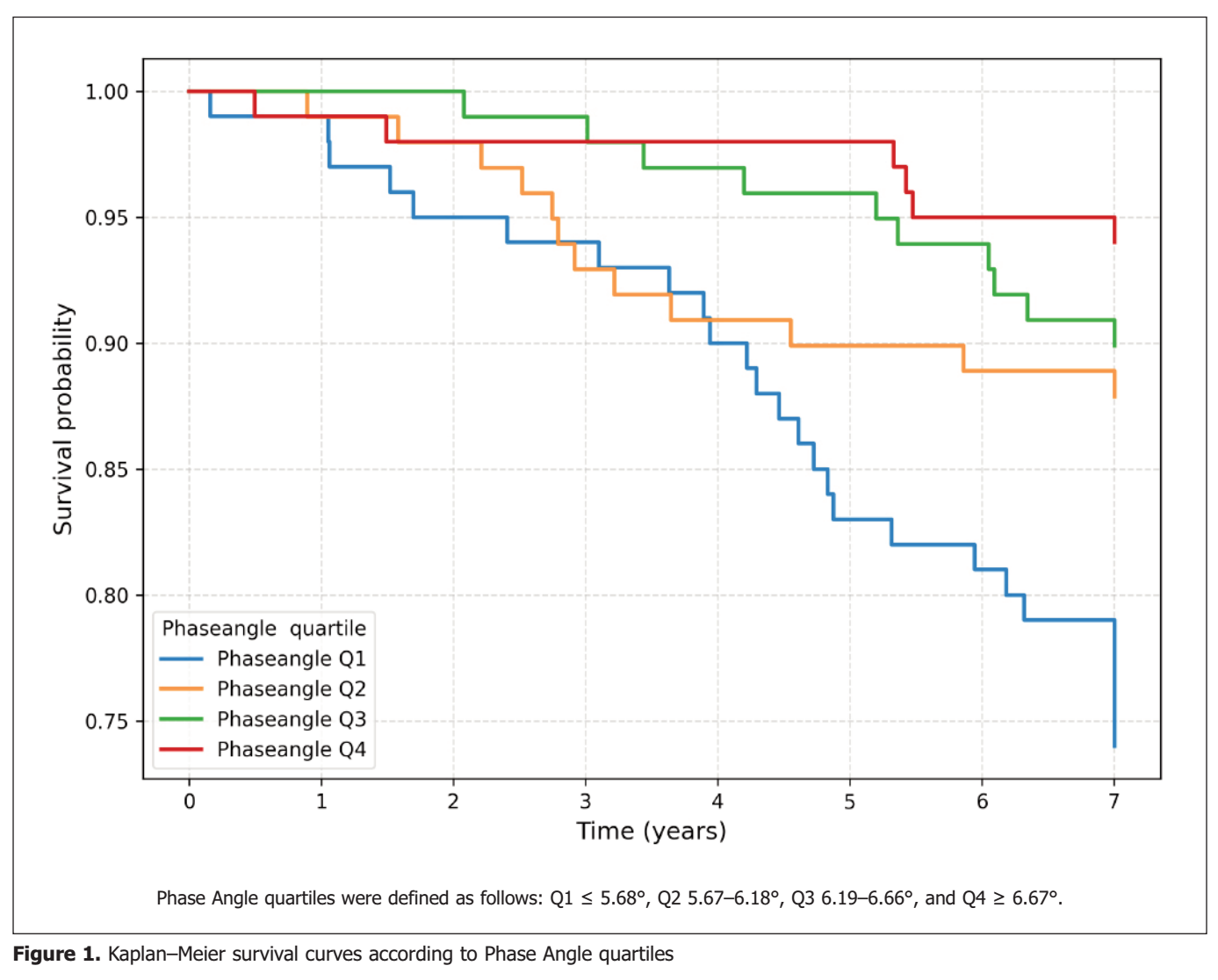
Kaplan–Meier survival analysis showed significant differences in all-cause mortality across Phase Angle quartiles during the seven-year follow-up period (Figure 1). Participants in the lowest Phase Angle quartile (Q1) exhibited the lowest survival probabilities over time, whereas progressively higher quartiles (Q2–Q4) demonstrated increasingly favorable survival trajectories. Individuals in the highest quartile (Q4) consistently showed the greatest survival probability throughout follow-up. Overall differences between survival curves were statistically significant according to the log-rank test (p < 0.001), indicating a strong association between baseline Phase Angle quartiles and long-term mortality.
DISCUSSION
The present study demonstrated a strong and graded association between phase angle (PhA) and all-cause mortality in older adults. Lower PhA values were associated with a significantly increased risk of death, whereas progressively higher PhA quartiles were linked to substantially greater survival. Importantly, this association remained robust after adjustment for age, sex, and comorbidity burden, as assessed by the Charlson Comorbidity Index.
Previous studies have consistently shown that lower PhA values are associated with poorer prognosis and higher mortality risk across diverse clinical populations12,21,22. In this context, several PhA cut-off points have been proposed, typically ranging from ≤4.5° to ≤6.0°, although these thresholds vary considerably according to population characteristics, disease status, and age23–25. Rather than proposing a single cut-off, the present study adopted a quartile-based approach to capture relative changes in mortality risk across the PhA spectrum. This strategy provides novel insight by demonstrating that transitions between PhA quartiles, even without crossing conventional cut-off thresholds, are associated with meaningful differences in survival, underscoring the clinical relevance of modest improvements in PhA among older adults. When PhA was analyzed using quartiles, a dose–response relationship emerged. Individuals in the highest quartile (Q4) exhibited approximately a 70–75% lower hazard of death compared with those in the lowest quartile (Q1). This progressive reduction in mortality risk across increasing quartiles highlights the biological gradient underlying PhA, whereby incremental increases are likely to reflect improvements in cellular membrane integrity, metabolic efficiency, and overall physiological reserve2–6,26. In contrast to dichotomous classifications or fixed cut-off values, a quartilebased approach allows for a more nuanced assessment of how mortality risk decreases gradually across the distribution of PhA values.
From a clinical standpoint, these findings reinforce the potential of PhA as an accessible, non-invasive biomarker for risk stratification and longitudinal monitoring in geriatric care in different clinical contexts13,15,27. Integrating PhA assessment into comprehensive geriatric evaluations and classifying individuals by PhA quartiles could therefore refine prognostic models and improve individualized care planning from physical exercise programs, multimodal rehabilitation strategies and nutritional interventions28,29. It is important to consider that the cut data was collected using the Biodynamics 310™ instrument (Biodynamics Corp., USA). This instrument is validated and has been widely used in countries such as Brazil, particularly in the elderly population30,31. It is a low-cost tool that provides the same ratio for evaluating muscle mass as other gold standards such as DEXA and magnetic resonance imaging (MRI)32,33.
Despite its strengths, the present study has limitations. First, although the longitudinal design enhances causal inference, residual confounding cannot be excluded, particularly from unmeasured factors such as inflammatory status, nutritional intake, or physical activity. Second, the study cohort consisted primarily of older adults, and findings may not extrapolate to younger populations or specific disease cohorts. Third, these cut points obtained in this study were with the Biodynamics 310™ instrument, so there may be variability if done with another type or bioimpedance model. Fourth, the quartile thresholds were derived empirically from the present sample and require validation in independent cohorts to establish universal or region-specific cut-points for mortality risk prediction. Finally, this study does not include older adults with functional dependence or cognitive impairment, limiting the extrapolation of the results to more frail geriatric populations. Therefore, future studies should incorporate the identification of new clinically useful prognostic thresholds for PhA to stratify risk and predict survival in these populations.
CONCLUSION
This study provides novel evidence that evaluating PhA by quartiles offers a clinically meaningful framework to estimate mortality risk in older adults. Higher PhA quartiles were associated with progressively lower hazard ratios, suggesting a protective, dose-dependent effect of improved cellular health on survival. These findings support the incorporation of PhA into comprehensive geriatric and nutritional assessments and highlight the need for multicenter studies to standardize PhA cut points across population, including frail older adults with functional dependence or cognitive impairment.
REFERENCES
- Mundstock E, Amaral MA, Baptista RR, et al. Association between phase angle from bioelectrical impedance analysis and level of physical activity: Systematic review and meta-analysis. Clinical Nutrition. 2019;38(4):1504-1510. doi:https://doi.org/10.1016/j.clnu.2018.08.031
- Bellido D, García-García C, Talluri A, Lukaski HC, García-Almeida JM. Future lines of research on phase angle: Strengths and limitations. Rev Endocr Metab Disord. 2023;24(3):563-583. doi:10.1007/S11154-023-09803-7
- Gonzalez MC, Barbosa-Silva TG, Bielemann RM, Gallagher D, Heymsfield SB. Phase angle and its determinants in healthy subjects: Influence of body composition. American Journal of Clinical Nutrition. 2016;103(3):712-716. doi:10.3945/ajcn.115.116772
- Norman K, Stobäus N, Pirlich M, Bosy-Westphal A. Bioelectrical phase angle and impedance vector analysis - Clinical relevance and applicability of impedance parameters. Clinical Nutrition. 2012;31(6):854-861. doi:10.1016/j.clnu.2012.05.008
- Sepúlveda Loyola WA, Vilaça Cavallari Machado F, Araújo de Castro L, et al. Is oxidative stress associated with disease severity, pulmonary function and metabolic syndrome in chronic obstructive pulmonary disease? Rev Clin Esp. 2019;219(9):477-484. doi:10.1016/j.rce.2019.04.007
- Sepulveda Loyola W, Silva Díaz YA, Odar Rojas CE, et al. Association between phase angle and blood biomarkers in community-dwelling older adults: The role of BDNF and oxidative stress. Nutrición Clínica y Dietética Hospitalaria. 2025;45(2). doi:10.12873/452sepulveda
- De Benedetto F, Marinari S, De Blasio F. Phase angle in assessment and monitoring treatment of individuals with respiratory disease. Rev Endocr Metab Disord. 2023;24(3):491-502. doi:10.1007/S11154-023-09786-5
- Kwon YE, Lee JS, Kim J young, et al. Impact of sarcopenia and phase angle on mortality of the very elderly. J Cachexia Sarcopenia Muscle. 2023;14(1):279-287. doi:10.1002/JCSM.13128
- Xia XX, Li CX, Xue XX, Chen YJ, He F, Guo HR. Association between phase angle and all-cause mortality in adults aged 18-49 years: NHANES 1999-2004. Sci Rep. 2025;15(1). doi:10.1038/S41598-025-86825-Y
- Fernández-Jiménez R, Dalla-Rovere L, García-Olivares M, et al. Phase Angle and Handgrip Strength as a Predictor of Disease-Related Malnutrition in Admitted Patients: 12-Month Mortality. Nutrients. 2022;14(9). doi:10.3390/NU14091851
- Sieber CC. Malnutrition and sarcopenia. Aging Clin Exp Res. 2019;31(6):793-798. doi:10.1007/S40520-019-01170-1
- Norman K, Pichard C, Lochs H, Pirlich M. Prognostic impact of disease-related malnutrition. Clinical Nutrition. 2008;27(1):5-15. doi:10.1016/J.CLNU.2007.10.007
- Mella De Cuevas KM, Sepúlveda-Loyola W, Araya-Quintanilla F, Morselli JD, Molari M, Probst VS. Association between clinical measures for the diagnosis of osteosarcopenia with functionality and mortality in older adults: longitudinal study. Nutrición Clínica y Dietética Hospitalaria. 2022;42(3):143-151. doi:10.12873/423sepulveda
- Xia XX, Li CX, Xue XX, Chen YJ, He F, Guo HR. Association between phase angle and all-cause mortality in adults aged 18–49 years: NHANES 1999–2004. Scientific Reports 2025 15:1. 2025; 15(1):1-9. doi:10.1038/s41598-025-86825-y
- Sepúlveda Loyola W, de Barros Morselli J, Araya Quintanilla F, et al. Clinical impact of osteosarcopenia on mortality, physical function and chronic inflammation: a 9-year follow up cohort study. Nutricion Clinica y Dietetica Hospitalaria. 2023;43(4):133-140. doi:10.12873/434sepulveda
- Sánchez-Torralvo FJ, Pérez-del-Río V, Navas Vela LI, et al. Phase Angle as a Predictor of Mortality in Older Patients with Hip Fracture. Nutrients. 2024;16(14):2221. doi:10.3390/NU16142221
- Malta M, Cardoso LO, Bastos FI, Magnanini MMF, da Silva CMFP. STROBE initiative: guidelines on reporting observational studies. Rev Saude Publica. 2010;44(3):559-565. doi:10.1590/S0034-89102010000300021
- Spirduso W. Physical Dimensions of Aging. (Champaign: Human Kinetics, ed.).; 1995.
- Bertolucci PHF, Brucki SMD, Campacci SR, Juliano Y. O Mini-Exame do Estado Mental em uma população geral: impacto da escolaridade. Arq Neuropsiquiatr. 1994;52(1):01-07. doi:10.1590/S0004-282X1994000100001
- Charlson ME, Charlson RE, Peterson JC, Marinopoulos SS, Briggs WM, Hollenberg JP. The Charlson comorbidity index is adapted to predict costs of chronic disease in primary care patients. J Clin Epidemiol. 2008;61(12):1234-1240. doi:10.1016/j.jclinepi.2008.01.006
- Kwon YE, Lee JS, Kim J young, et al. Impact of sarcopenia and phase angle on mortality of the very elderly. J Cachexia Sarcopenia Muscle. 2023;14(1):279-287. doi:10.1002/JCSM.13128
- Mattiello R, Amaral MA, Mundstock E, Ziegelmann PK. Reference values for the phase angle of the electrical bioimpedance: Systematic review and meta-analysis involving more than 250,000 subjects. Clin Nutr. 2020;39(5):1411-1417. doi:10.1016/J.CLNU.2019.07.004
- Xia XX, Li CX, Xue XX, Chen YJ, He F, Guo HR. Association between phase angle and all-cause mortality in adults aged 18–49 years: NHANES 1999–2004. Scientific Reports 2025 15:1. 2025; 15(1):1-9. doi:10.1038/s41598-025-86825-y
- Fernández-Jiménez R, Dalla-Rovere L, García-Olivares M, et al. Phase Angle and Handgrip Strength as a Predictor of Disease-Related Malnutrition in Admitted Patients: 12-Month Mortality. Nutrients. 2022;14(9). doi:10.3390/NU14091851
- Bellido D, García-García C, Talluri A, Lukaski HC, García-Almeida JM. Future lines of research on phase angle: Strengths and limitations. Rev Endocr Metab Disord. 2023;24(3):563-583. doi:10.1007/S11154-023-09803-7
- Barros-Osorio C, Sepulveda Loyola W, Astudillo I, Campos-Aguayo J, Valenzuela-Fuenzalida JJ, Suziane Probst V. Correlación entre marcadores inflamatorios con función física y composición corporal en adultos mayores de la comunidad: estudio transversal. Nutricion Clinica y Dietetica Hospitalaria. 2024;44(2). doi: https://doi.org/10.12873/442barros
- Checa-Lopez M, Rodriguez-Laso A, Carnicero JA, et al. Differential utility of various frailty diagnostic tools in non-geriatric hospital departments of several countries: A longitudinal study. Eur J Clin Invest. 2023;53(7). doi:10.1111/eci.13979
- De Benedetto F, Marinari S, De Blasio F. Phase angle in assessment and monitoring treatment of individuals with respiratory disease. Rev Endocr Metab Disord. 2023;24(3):491-502. doi:10.1007/S11154-023-09786-5
- Gonzalez MC, Barbosa-Silva TG, Bielemann RM, Gallagher D, Heymsfield SB. Phase angle and its determinants in healthy subjects: influence of body composition. Am J Clin Nutr. 2016; 103(3):712-716. doi:10.3945/AJCN.115.116772
- Rech CR, Cordeiro BA, Petroski EL, Vasconcelos FAG. Validation of bioelectrical impedance for the prediction of fat-free mass in Brazilian elderly subjects. Arq Bras Endocrinol Metab. 2008; 52(7):1163-71.
- Mainenti MRM, Rodrigues É de C, Oliveira JF de, Ferreira A de S, Dias CM, Silva AL dos S. Adiposity and postural balance control: correlations between bioelectrical impedance and stabilometric signals in elderly Brazilian women. Clinics. 2011;66 (9): 1513-1518. doi:10.1590/S1807-59322011000900001.
- Son JW, Han BD, Bennett JP, Heymsfield S, Lim S. Development and clinical application of bioelectrical impedance analysis method for body composition assessment. Obesity Reviews. 2025;26(1):e13844.
- Ponti F, Santoro A, Mercatelli D, Gasperini C, Conte M, Martucci M, et al. Aging and Imaging Assessment of Body Composition: From Fat to Facts. Front Endocrinol. 2020;10:861.
Explorar
Artículos
Volúmenes
Sobre la revista
Más leídos
Consumo de bebidas energizantes y efectos adversos en la salud de estudiantes universitarios
Nutrición Clínica y Dietética Hospitalaria
Uso de redes sociales y riesgo de trastornos de conducta alimentaria en adolescentes mujeres de un colegio en Lima, Perú
Nutrición Clínica y Dietética Hospitalaria
Consumo de bebidas energizantes en estudiantes universitarios y sus factores asociados.
Nutrición Clínica y Dietética Hospitalaria
Microbiota intestinal y eje intestino-cerebro: una revisión de su interacción con el sistema nervioso central
Nutrición Clínica y Dietética Hospitalaria
Factores asociados a la diabetes mellitus tipo 2 de la población adulta peruana.
Nutrición Clínica y Dietética Hospitalaria