Artículo original
Vol. 46 Núm. 1 (2026)
19 min
Determination of the chemical and sensory quality of yellow pitahaya wine (Hylocereus megalanthus) using different layers and fermentation times
Tanya Melody MUZO BRIONES1, Jonathan Alexander ARGUELLO CEDEÑO1, Karol Yannela REVILLA ESCOBAR2, Jhonnatan Placido ALDAS MOREJON1,3, Juan Alejandro NEIRA MOSQUERA2,4,5, Sungey Naynee SANCHEZ LLAGUNO4
1 Pontificia Universidad Católica del Ecuador, Esmeraldas, Ecuador.
2 Universidad Pública de Santo Domingo de los Tsáchilas - UPSDT- Quevedo, Ecuador.
3 Facultad de Ciencias Aplicadas a la Industria, Universidad Nacional de Cuyo, San Rafael, , Argentina.
4 Departamento de Ciencias de la Vida y Agricultura, Universidad de las Fuerzas Armadas (ESPE), Sangolquí, Ecuador.
5 Facultad de Ciencias de la Industria y Producción, Universidad Técnica Estatal de Quevedo, Quevedo, Ecuador.
*Correspondencia:
Jhonnatan Placido Aldas Morejon jhonnatanaldas719@gmail.com
Recepción:
02/02/2026
Aceptación:
01/04/2026
Publicación:
31/03/2026
Cómo citar
Tanya Melody MUZO BRIONES, Jonathan Alexander ARGUELLO CEDEÑO, Karol Yannela REVILLA ESCOBAR, Jhonnatan Placido ALDAS MOREJON, Juan Alejandro NEIRA MOSQUERA, Sungey Naynee SANCHEZ LLAGUNO. Determination of the chemical and sensory quality of yellow pitahaya wine (Hylocereus megalanthus) using different layers and fermentation times. Nutr Clín Diet Hosp. 2026; 46(1):541-548 DOI: 10.12873/NCDH-2026-31
Métricas
266
Visualizaciones
51
Descargas
Compartir
Compartir
Resumen (EN)
Introduction: Diversifying raw materials in winemaking represents an innovative alternative for the agro-industrial use of non-traditional fruits. In this context, yellow pitahaya (Hylocereus megalanthus) stands out for its physicochemical and sensory characteristics, making it a potential substrate for the production of fermented wines.
Objective: To evaluate the physicochemical and sensory quality of a wine made from yellow pitahaya (H. megalanthus) using different yeast strains and fermentation times.
Materials and Methods: A completely randomized 2×2 factorial design was used to analyze the effect of two factors: yeast strains (factor A) and fermentation time (factor B), generating four treatments with three replicates per treatment, for a total of 12 experimental units. To determine significant differences between treatments, analysis of variance (ANOVA) and Tukey’s multiple range test (p < 0.05) were applied using the InfoStat statistical software. Results: The analyses showed pH values between 3.46 ± 0.02 and 3.84 ± 0.03, Brix degrees between 14.67 ± 0.15 and 17.67 ± 0.18, and alcohol content between 8.30 ± 0.12% and ± 0.10%. Treatment T4 presented the highest sensory scores for odor (4.61 ± 0.08), color (4.60 ± 0.07), flavor (4.90 ± 0.05), texture (4.60 ± 0.06), and overall acceptability (4.90 ± 0.04).
Conclusion: The use of Saccharomyces cerevisiae var. The fermentation of Saccharomyces cerevisiae for 15 days allows for the production of pitahaya wine with suitable physicochemical characteristics and high sensory acceptability.
Palabras clave (EN):
Ethanol content
Saccharomyces bayanus
oenological quality control
controlled fermentation
INTRODUCTION
The wine industry is a key sector in the global economy, encompassing everything from raw material production to processing and marketing, and whose evolution has been driven by technological advances, regulations, and improvements in production processes1. The dragon fruit or yellow pitahaya (Hylocereus megalanthus), rich in vitamins, minerals, and antioxidants, is prized not only for its nutrients but also for its great potential in the creation of high-priced products such as wine2.
Ecuador is a key producer of yellow pitahaya (H. megalanthus), with Morona Santiago accounting for 65% of production sites and Manabí for 8%. Its cultivation extends to the provinces of Pichincha, Imbabura, and Loja, boosting fruit exports3. In addition, its production takes place under specific agroecological conditions, with humid subtropical climates, temperatures between 18 and 25 °C, and relative humidity above 50%. These characteristics favor the quality of the fruit and its acceptance in international markets4. In Ecuador, the sustainability of pitahaya production varies according to the management system; conventional farms achieve an economic sustainability of 2.7 and organic farms 1.5, while the environmental and social indicator is 3 in both cases5.
The yellow pitahaya (H. megalanthus) has very large white flowers measuring 32-38 cm, with a superior appearance to other varieties. Its fruit is characterized by a yellow rind with spines and juicy white pulp, which accounts for 60-80% of its total weight6. The proportion of pulp increases to 62.64%, while the rind decreases to 34.56% of the total weight, meaning that the rind/pulp ratio decreases as the fruit ripens, making it more suitable for consumption and agro-industrial use7.
This particular fruit is recognized for its outstanding nutritional content, as every 100 grams of pulp provides 85% water, 13.6 g of carbohydrates, and 0.5 g of dietary fiber, as well as 20 mg of vitamin C, along with essential minerals such as calcium (10 mg), phosphorus (16 mg), and iron (0.3 mg), which underscores its value as a source of beneficial nutrients8.
The production of yellow pitahaya wine involves fermentation and maturation in containers suitable for preserving its organoleptic characteristics. Under anaerobic conditions, yeasts generate alcohol, providing stability and sensory attributes, since the addition of sugar promotes fermentation, but in excess can inhibit yeast activity9. The vinification of yellow pitahaya involves 14 days of fermentation and maturation, with 30 days optimizing microbiological (3.50 CFU/g of Escherichia coli) and sensory (smell, color, taste) quality, surpassing results obtained in longer periods10.
Yeasts such as Saccharomyces cerevisiae are also used in wine fermentation processes, being the most widely used due to their rapid growth and high capacity to ferment glucose, which they use as their main source of energy11. This yeast is commonly used in winemaking due to its efficiency in converting sugars into ethanol and CO2 12. On the other hand, Saccharomyces bayanus, used especially in wine production, is characterized by its resistance to sulfur compounds and its ability to ferment at temperatures between 12-35 °C, withstanding up to 16% alcohol by volume, which makes it suitable for more demanding fermentation processes12.
Given the above, the objective of this study was to determine the chemical and sensory quality of yellow pitahaya (H. Megalanthus) wine using different strains and fermentation times.
MATERIALS AND METHODS
Raw material
Yellow pitahaya (Hylocereus megalanthus) was obtained from local markets in the province of Esmeraldas, Ecuador. The fruits were selected according to uniform maturity stage, absence of mechanical damage and microbial deterioration, similar average weight, and comparable initial soluble solids content in order to reduce variability in the raw material.
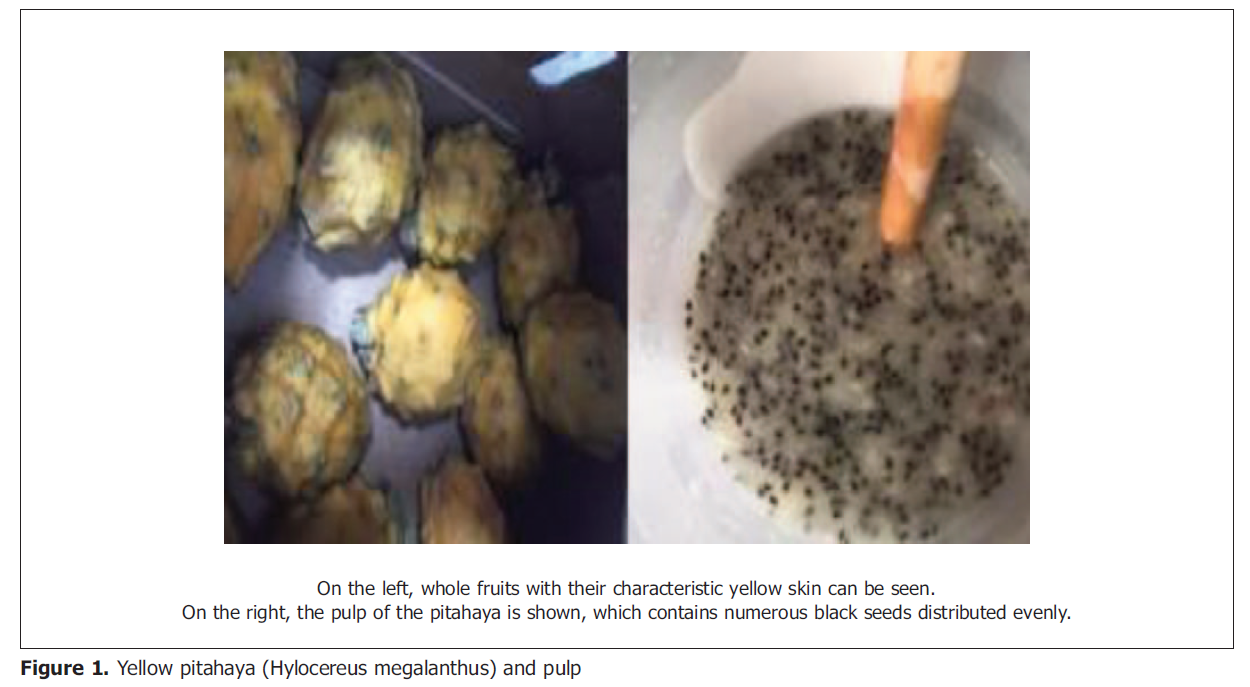
The process of producing pitahaya wine using different yeast strains and fermentation times was carried out in the Agroindustries Laboratory of the Pontificia Universidad Católica del Ecuador, Esmeraldas Campus – Tachina Campus, located at latitude 0.9730661 and longitude −79.6249446.
Experimental design
A factorial design A*B was implemented to evaluate the effect of two factors: yeast strains (A) and fermentation time (B), involving a total of 4 treatments with 3 replicates. To determine the difference between the mean of the treatments, a Tukey multiple range test (p<0.05) was applied using Infostat statistical software. The levels of the factors are described in Table 1. A completely randomized factorial design (A×B) was implemented to evaluate the effect of two factors: yeast strain (Factor A) and fermentation time (Factor B).
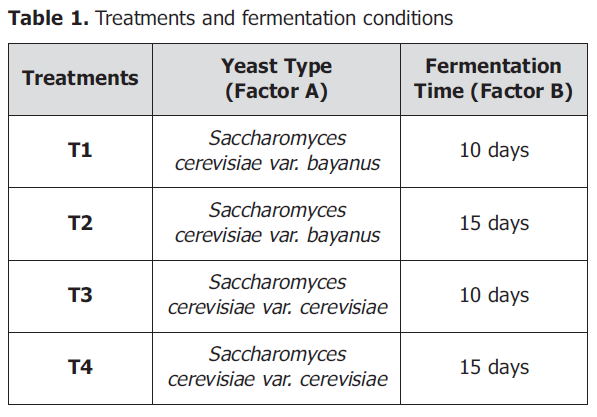
Factor A consisted of two yeast strains:
- Saccharomyces cerevisiae var. bayanus
- Saccharomyces cerevisiae var. cerevisiae
Factor B corresponded to two fermentation times:
- 10 days
- 15 days
The combination of factors generated four treatments, each with three independent replicates, resulting in a total of 12 experimental units. Each replicate corresponded to an independent fermentation batch, ensuring statistical independence among experimental units. Treatments were randomly assigned to the fermentation units to avoid systematic bias.
To determine significant differences among treatments, analysis of variance (ANOVA) was performed. When significant differences were detected, treatment means were compared using the Tukey multiple comparison test (p < 0.05) using Infostat statistical software. Prior to ANOVA, the assumptions of normality and homogeneity of variances were verified.
Experimental procedure
The raw material was washed and disinfected before juice extraction. The must was prepared using 2 kg of pitahaya pulp, 500 mL of water, and 2 g of yeast per experimental unit, corresponding to the strains Saccharomyces cerevisiae var. bayanus and Saccharomyces cerevisiae var. cerevisiae, depending on the treatment.
The must was adjusted to 22 °Brix prior to fermentation. This value is slightly higher than that reported by Gong et al. (2017), who adjusted pitahaya must to 20 °Brix during fermentation. Differences in the initial sugar concentration may influence fermentation kinetics, ethanol production, and sensory characteristics of the final product13.
Additionally, the initial pH and density of the must were measured prior to inoculation to ensure uniformity among treatments and to monitor fermentation performance. The prepared must was divided into independent fermentation batches according to the experimental design.
Fermentation was carried out in hermetically sealed glass containers under laboratory conditions at temperatures ranging between 28 and 30 °C, which were periodically monitored during the fermentation process. The fermentation times evaluated were 10 and 15 days, according to the experimental design.
These fermentation times are shorter than those reported by Dimero and Tepora (2018), who fermented pitahaya wine for three to four weeks until complete sugar conversion14. Therefore, the shorter fermentation period used in this study could influence the final ethanol concentration, fermentation stability, and sensory properties of the wine.
Periodic measurements and chemical analyses were conducted to monitor fermentation progress and evaluate the quality attributes of the resulting wine. This experimental approach is comparable to studies on the production of young wine from borojó (Borojoa patinoi Cuatrec), in which the must composition is adjusted and divided into fermentation batches to evaluate the effect of treatments on wine quality15.
Physical and chemical characterizations
pH determination: A 50 mL sample of wine from each treatment was analyzed using a Milwaukee pH58 MAX potentiometer. The electrode was immersed directly in the sample and the pH value corresponding to each treatment was recorded16.
Quantification of alcohol content: Alcohol content was determined using the alcoholmeter method established in the Ecuadorian Technical Standard NTE INEN 0340:2014. A 20 mL sample was distilled and ethanol concentration was measured in the final stage of the distillation process17.
Brix content: Soluble solids content was measured using an ATC 0–90% refractometer, placing two drops of the sample on the prism of the instrument.
Sensory characterization: Sensory analysis was carried out using a panel of untrained judges selected from the university community. Participants volunteered to take part in the evaluation and had no previous sensory training.
Samples were coded with random three-digit numbers and presented in randomized order to avoid bias. The panel evaluated the samples using a five-point hedonic scale, where:
1 = Dislike very much
2 = Dislike
3 = Neither like nor dislike
4 = Like
5 = Like very much
The attributes evaluated were aroma, color, taste, texture, and overall acceptability.
Although hedonic scale data are ordinal, statistical analysis was performed using ANOVA and Tukey tests (p < 0.05) after verifying the assumptions of normality. When these assumptions were not met, appropriate non-parametric analysis was considered.
RESULTS
Physicochemical characterization
Table 2 shows the physicochemical results of pitahaya wine produced using different yeast strains and fermentation times, where significant differences (p < 0.05) were observed in the variables pH, °Brix, and alcohol content. The results are expressed as mean ± standard deviation, and different letters indicate statistically significant differences according to Tukey’s test.
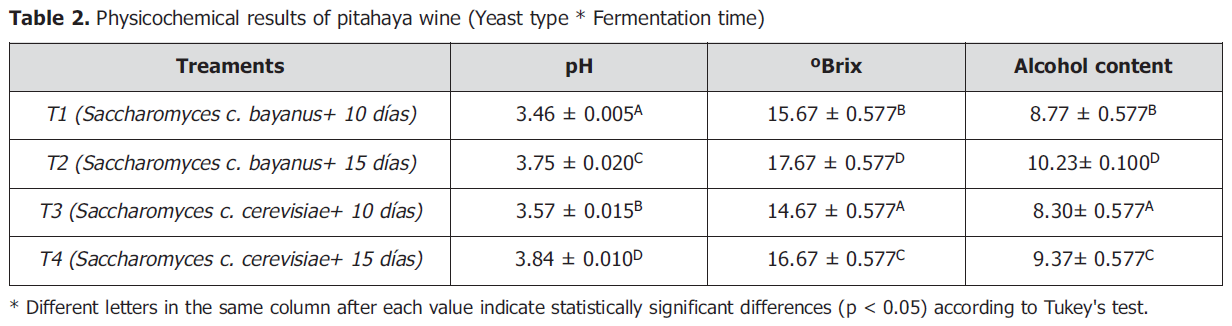
Regarding the pH of pitahaya wine, the highest value was obtained in T4 (Saccharomyces cerevisiae var. cerevisiae + 15 days) with 3.84 ± 0.01, while the lowest pH was found in T1 (Saccharomyces cerevisiae var. bayanus + 10 days) with 3.46 ± 0.01. Thus, it was determined that treatment T4 was statistically different (p < 0.05) from treatments T1, T2 (S. cerevisiae var. cerevisiae + 10 days) with 3.57 ± 0.01, and T3 (S. cerevisiae var. bayanus + 15 days) with 3.75 ± 0.01. These results indicate that longer fermentation periods combined with S. cerevisiae var. cerevisiae tend to increase the pH of the wine, possibly due to changes in the balance of organic acids during fermentation.
With regard to °Brix, significant differences (p < 0.05) were observed between treatments. The highest value was obtained in T2 (S. cerevisiae var. bayanus + 15 days) with 17.67 °Brix, while the lowest corresponded to T3 (S. cerevisiae var. cerevisiae + 10 days) with 14.67 °Brix. These results suggest that the type of yeast and fermentation time significantly influence the residual sugar content of the wine. The higher °Brix value observed in T2 indicates a greater concentration of residual sugars, suggesting that sugar consumption during fermentation may have been lower in this treatment compared with the others. Therefore, the °Brix results should be interpreted as an indicator of residual sugars rather than fermentation efficiency.
In relation to alcohol content, it was observed that T2 (S. cerevisiae var. bayanus + 15 days) with 10.23 ± 0.04% was statistically different (p < 0.05) from T3 (S. cerevisiae var. cerevisiae + 10 days), which obtained an alcohol content of 8.30 ± 0.04%. These results indicate that the use of S. cerevisiae var. bayanus combined with a longer fermentation period may favor higher alcohol production; however, this should be interpreted considering the residual sugar levels observed in the °Brix values.
Sensory characterization
Table 3 shows the sensory evaluation results obtained for the different treatments applied to pitahaya wine. Significant differences (p < 0.05) were observed among treatments for the sensory attributes smell, color, taste, texture, and acceptability.
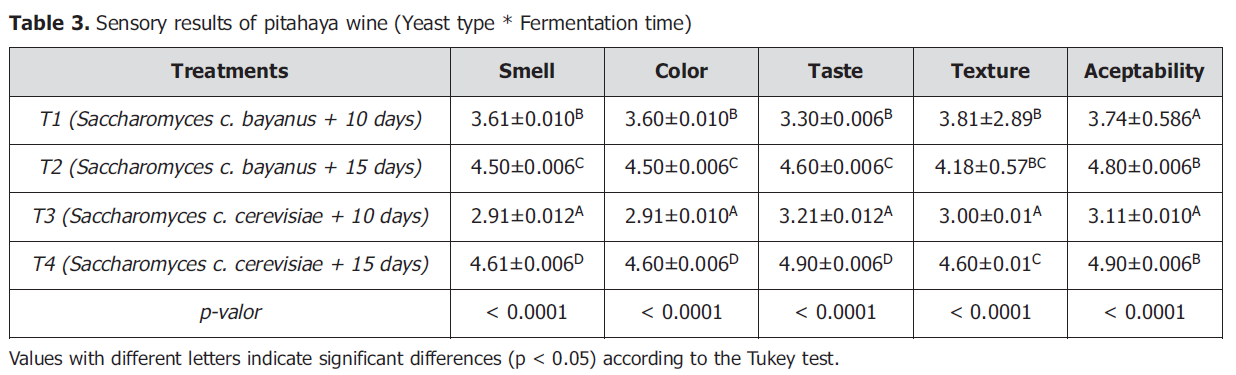
In relation to the odor category, it was determined that Factor A (yeast type), Factor B (fermentation time), and their interaction (A×B) were highly significant (p < 0.0001). Treatment T4 presented the highest score with a value of 4.61, indicating a more intense and pleasant aroma, whereas T3 obtained the lowest score with a value of 2.91.
Regarding color, both factor A (yeast type), factor B (fermentation time), and their interaction (A×B) were also highly significant (p < 0.0001). In particular, the combination of Saccharomyces cerevisiae var. cerevisiae with 15 days of fermentation (T4) resulted in the highest score (4.60), indicating better visual acceptance by the panelists. In contrast, the same yeast with a shorter fermentation time (T3) obtained the lowest score (2.91).
Similarly, for taste, significant differences were observed among the factors evaluated (p < 0.0001). Treatment T4 showed the highest intensity with a value of 4.90, suggesting a more favorable flavor perception, whereas treatment T3 obtained the lowest value (3.21).
In the case of texture, significant differences were also detected between the treatments (p < 0.05). The highest score was observed in treatment T4 (4.60), while treatment T3 obtained the lowest value (3.00), corresponding to the descriptor “neither like nor dislike”. However, it should be noted that the standard deviation reported for treatment T1 (3.81 ± 2.89) represents an unusually high dispersion considering that the hedonic scale ranges from 1 to 5. Therefore, this value should be verified to confirm that no calculation or transcription error occurred in the dataset.
Finally, in terms of acceptability, the results showed that both the type of yeast (Factor A), fermentation time (Factor B), and their interaction (A×B) were highly significant (p < 0.0001). Treatment T4 obtained the highest score (4.90), indicating the highest overall acceptance among the panelists, whereas treatment T3 obtained the lowest score (3.11). Overall, treatment T4 (Saccharomyces cerevisiae var. cerevisiae + 15 days) showed the best sensory performance across most attributes evaluated.
Principal component analysis
Figure 2 shows the principal component analysis (PCA) of the sensory attributes evaluated in pitahaya wine. The first two principal components explained 97.0% of the total variability of the data, indicating a strong representation of the sensory characteristics in the multivariate space.
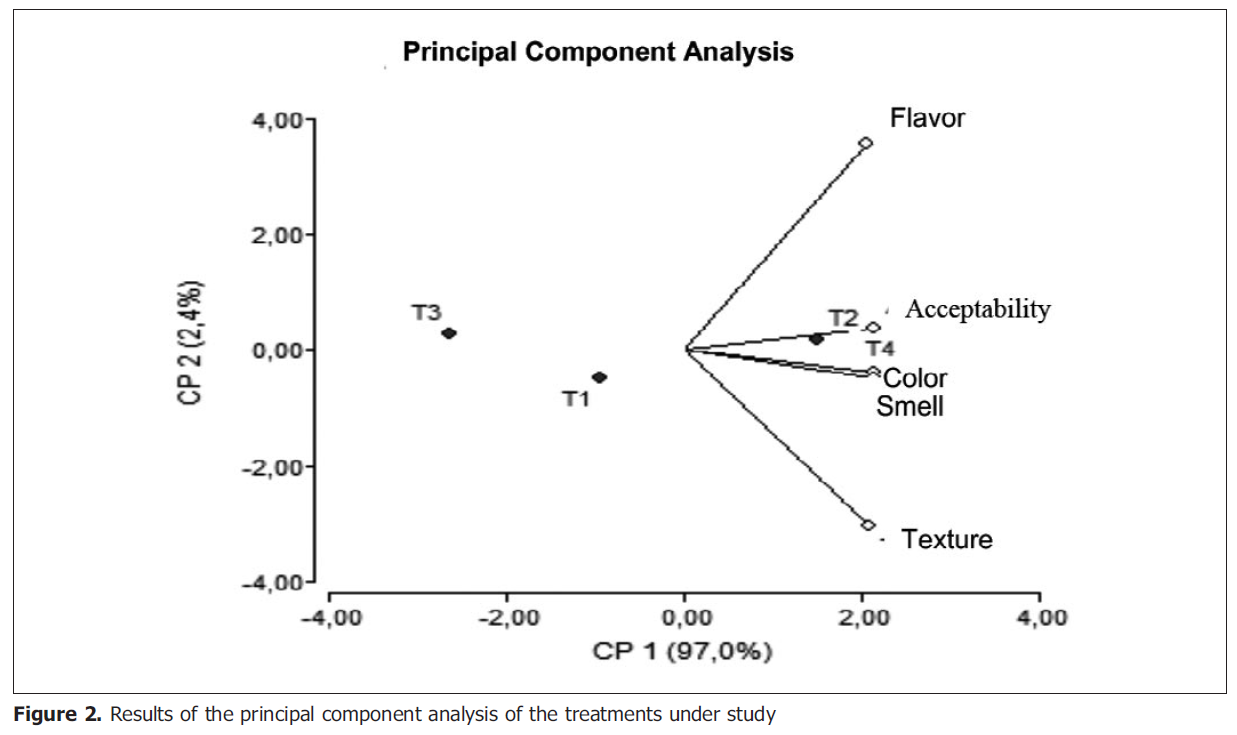
Treatments T2 and T4 were located in the positive region of CP1, associated with higher scores in the sensory attributes of flavor, acceptability, smell, and texture, indicating greater preference among the panelists. In contrast, treatments T1 and T3 were located in the negative region of CP1, reflecting lower sensory acceptance.
For a clearer interpretation of the multivariate structure, it is recommended to report the percentage of variance explained by each principal component (CP1 and CP2) and the factor loadings associated with the evaluated sensory variables, as these parameters allow better understanding of the contribution of each attribute to the discrimination among treatments.
DISCUSION
Physicochemical parameters in the characterization of pitahaya wine.
When Saccharomyces cerevisiae var. cerevisiae was used during a 15-day fermentation period, a significant increase in the wine’s pH values was observed. Studies of wines made from tropical fruits documented an increase in pH in wines made from tropical fruits when using S. cerevisiae in prolonged fermentations, reaching values of up to 4.0018. Similarly, in studies where an alcoholic beverage based on carambola (Averrhoa carambola) was developed using S. cerevisiae during 9 days of fermentation at room temperature (~25 °C) and without agitation, pH values in the range of 4.13 to 4.22 were obtained, indicating a consistent trend toward increased pH in this type of fermentation process19.
With regard to soluble solids content (°Brix), the results obtained in this study ranged from 14.67 to 17.67, varying according to the type of yeast and fermentation time. This trend indicates a decrease in sugar content during alcoholic fermentation, attributed to yeast metabolism, which is consistent with the fermentation behavior in wine made from red pitahaya (Hylocereus costaricensis), where a progressive decrease in °Brix was observed during the fermentation of wine made from red pitahaya (Hylocereus costaricensis), where initial values between 24 and 32 °Brix decreased to a range of 14.67 to 17.67. Brix values in the fermentation of wine made from red pitahaya (Hylocereus costaricensis), where initial values between 24 and 32 °Brix decreased to a range of 10.1 to 14.5 °Brix after six months of fermentation20. The differences between the values recorded in both studies may be due to both the type of fruit (yellow vs. red) and the specific conditions of the fermentation process. In addition, previous research has shown that the use of Saccharomyces cerevisiae var. bayanus in the fermentation of apple musts generates a more significant reduction in °Brix content, demonstrating the greater fermentation efficiency of this strain compared to other types of strains21.
It was observed that the use of Saccharomyces cerevisiae var. bayanus during a 15-day fermentation period increased the alcohol content of the beverage, reaching a value of 10.23 ± 0.100 °GL. This result is consistent with studies on the production of artisanal liquor based on jackfruit (Artocarpus heterophyllus), which obtained a final alcohol content of 27°GL after optimizing the concentration of soluble solids in the must and extending fermentation for more than 12 days22. Likewise, it has been shown that different yeast strains, such as Saccharomyces cerevisiae, Torulaspora delbrueckii, and Lachancea thermotolerans, directly influence ethanol production during pitahaya wine fermentation, reaching concentrations between 8% and 9% v/v23.
Sensory characterization of pitahaya wine
It was determined that the Saccharomyces cerevisiae strain has a positive effect on the sensory attributes of pitahaya wine, especially when prolonged fermentation times (15 days) are used. Under these conditions, a significant improvement in organoleptic characteristics was observed, with attributes such as smell, color, taste, and overall acceptability of the product standing out. These results are consistent with recent research on mead fermentation, where the use of S. cerevisiae, either alone or in combination with Lactobacillus paracasei, has been shown to enhance the production of alcohol, phenolic compounds, flavonoids, and volatile compounds responsible for intensifying sensory properties24. In addition, studies on kiwi wine indicate that different strains of S. cerevisiae significantly modify the profile of volatile compounds such as esters and alcohols, improving the aroma, flavor, and acceptability of the final product25. The fermentation time (15 days) also improved the sensory characteristics of pitahaya wine, coinciding with studies showing that prolonged fermentation times improve the sensory quality of the final product and, therefore, consumer preference26.
CONCLUSION
This study evaluated how different yeast strains (Saccharomyces cerevisiae var. cerevisiae and S. cerevisiae var. bayanus) and fermentation times (10 and 15 days) influence the chemical and sensory quality of yellow pitahaya (Hylocereus megalanthus) wine. From a physicochemical point of view, significant differences (p<0.05) were observed in the variables pH, Brix degrees, and alcohol content. Treatment T4 (S. cerevisiae var. cerevisiae + 15 days) had the highest pH (3.84 ± 0.01), indicating a slight tendency toward lower acidity compared to the other treatments. On the other hand, treatment T2 (S. cerevisiae var. bayanus + 15 days) recorded the highest residual sugar content (17.67 °Brix) and the highest alcohol percentage (10.23% ± 0.04), demonstrating that this yeast strain, under prolonged fermentation, favors more efficient fermentation in alcohol. In terms of sensory characterization, the T4 treatment presented greater aromatic intensity, more attractive coloration, robust flavor, and pleasant texture, demonstrating the importance of proper fermentation in obtaining a wine with higher sensory quality. In conclusion, the combination of Saccharomyces cerevisiae var. cerevisiae and a fermentation time of 15 days (T4) significantly influenced the production of yellow pitahaya wine with optimal physicochemical and sensory characteristics. These findings are important for the emerging tropical fruit-based wine industry, as they establish technical parameters that improve the quality of the final product.
REFERENCES
- Tornello S, Hernández J. Characterization of artisanal wine producers: new players in San Juan. RIVAR. 2022; 9(25). doi:10.35588/rivar.v9i25.5420
- Truong NM, Văn TP, Dang M, Le U. Influences of Fermentation Conditions on the Chemical Composition of Red Dragon Fruit (Hylocereus polyrhizus) Wine. Beverages. 2024; 10(3): p. 1-19. doi:10.3390/beverages10030061.
- Menéndez Barrezueta RZ, Cobeña Andrade XA. Critical factors in the quality management of Ecuadorian pitahaya for export. Case study: Ecuador Divine-El Okaso S.A. Scientific Journal Dominio de la ciencia. 2022; 8(3). doi:10.23857/dc.v8i3.2946
- Huachi L, Yugsi E, Paredes MF, Coronel D, Verdugo K, Coba Santamaría P. Development of pitahaya (Cereus SP.) in Ecuador. La Granja: Journal of Life Sciences. 2015; 22(2). doi:10.17163/lgr.n22.2015.05
- Raffo Folleco LA, Torres Jaramillo LA, Beltran Rosero DS, Macías Vera JC. Pitahaya production using organic and conventional methods: A proposal for sustainability. Knowledge Hub. 2021; 6(11). doi:10.23857/pc.v6i11.3312
- Verona Ruiz A, Urcia Cerna J, Paucar Menacho LM. Pitahaya (Hylocereus spp.): Cultivation, physicochemical characteristics, nutritional composition, and bioactive compounds. Agricultural Science. 2020; 11(3). doi:/10.17268/sci.agropecu.2020.03.16
- Cañar Sena DY, Caetano C, Bonilla Morales MM. Physicochemical and proximal characterization of the fruit of yellow pitahaya [Selenicereus megalanthus (K. SCHUM. EX VAUPEL) MORAN] grown in Colombia. Agronomy Journal. 2014; 22(1). https://www.researchgate.net/publication/303446816_
- Cabezas Vergara me, uribe campaña re. evaluación de la tonalidad y pureza de color cie l*a*b de una bebida alcohólica de pitahaya (hylocereus undatus) con maíz morado (zea mays l) y flor de jamaica (hibiscus sabdariffa). [tesis], editor. [quevedo]: universidad técnica estatal de quevedo facultad ciencias de la industria y la producción; 2021. https://repositorio.uteq.edu.ec/items/5d644a12-e1cd-46d6-b96c-104d5a388810
- Juniarta IKW, Sudiarta IN. Kualitas Wine Berbahan Dasar Buah Naga. PARIS Jurnal Pariwisata dan Bisnis. 2024; 03(6): p. 951- 958. doi:10.22334/paris.v3i6
- Haro Altamirano JP, Cazorla Vinueza XR, Zambrano Cárdenas GO, Soplín H, Garzón R. Assessment of the sustainability of family farms growing two ecotypes of yellow pitahaya (Selenicereus megalanthus) and its by-product. Knowledge Hub. 2021; 6(12): p. 301-319. doi:10.23857/pc.v6i12.3369
- Suárez Machín C, Garrido Carralero NA, Guevara Rodríguez CA. Saccharomyces cerevisiae yeast and alcohol production. ICIDCA. About Sugarcane Derivatives. 2016; 50(1). https://www.redalyc.org/pdf/2231/223148420004.pdf
- Garcés Moncayo María Daniela VOYA. Physicochemical and kinetic evaluation of biomass production by two types of yeast, Saccharomyces cerevisiae and Saccharomyces bayanus, in the alcoholic fermentation of a beverage made from mandarin (Citrus reticulata) and soursop (Sechium edule) [Thesis], editor. [Ambato]: Technical University of Ambato. Faculty of Food Science and Engineering and Biotechnology. Food Science Degree Program. 2023. https://repositorio.uta.edu.ec/jspui/handle/123456789/37923
- Gong X, Yang Y, Ma, L, Peng S, Lin M. Fermentation and Characterization of Pitaya Wine. IOP Conference Series: Earth and Environmental Science. 2017; 100. doi:10.1088/1755-1315/100/1/012029
- imero FN, Tepora TF. Processing and Development of Dragon Fruit Wine. International Journal of Environment, Agriculture and Biotechnology (IJEAB). 2018; 3(5). doi:10.22161/ijeab/3.5.49
- García Zapateiro A, Florez Mendoza I, Marrugo Ligardo Y. Production and physicochemical characterization of a young wine made from borojó fruit (B patinoi Cuatrec). Science, teaching, and technology. 2016; 27(52): p. 507-519. https://www.scielo.org.ar/scielo.php?script=sci_arttext&pid=S1851-17162016000100020
- Garzón Aguila E. Development of an alcoholic beverage similar to yellow pitahaya wine (Selenicereus Megalanthus) from the Palora canton, Morona Santiago province [Thesis], editor. Quito: University of the Americas; 2019. https://dspace.udla.edu.ec/handle/33000/11759
- Haro Altamirano JP, Zambrano Cárdenas GO, Cazorla Vinueza XR, Soplín, Garzón R. Assessment of the sustainability of family farms growing two ecotypes of yellow pitahaya (Selenicereus megalanthus) and its by-product. Knowledge Hub. 2021; 6(12). doi:10.23857/pc.v6i12.3369
- Swiegers JH, Kievit RL, Siebert T, Lattey KA, Bramley BR, Francis IL, et al. The influence of yeast on the aroma of Sauvignon Blanc wine. Food Microbiology. 2009; 26(2). doi:10.1016/j.fm.2008.08.004
- Valim FdP, Oliveira EA, Kamimura ES, Dias Alves, Resende Maldonado. Production of Star Fruit Alcoholic Fermented Beverage. Indian Journal Microbiol. 2016; 56(4). doi:10.1007/s12088-016-0601-9
- Sudiarta IW, Saputra IWR, Singapurwa N, Candra I. Ethanol and methanol levels of red dragon fruit wine (Hylocereus costaricensis) with the treatment of sugar and fermentation time. Journal of Physics. 2021. doi:10.1088/1742-6596/1869/1/012032
- Andrade Albán MJ, Alvarado Carrasco JA. Fermentation behavior of wine and bread yeast in apple must with added pectolytic enzymes. InvestiGo Multidisciplinary Scientific Journal. 2022; 3(6). doi:10.56519/rci.v3i6.65
- Macas López CA, Medranda Vargas GN, Peña Macías AD. Proposal for the production of artisanal alcoholic beverages based on non-traditional exotic fruits such as cocona (Solanum sessiliflorum), jackfruit (Artocarpus heterophyllus), and salak (Salacca zalacca). Chemical Engineering and Development Journal. 2021; 4(1). https://revistas.ug.edu.ec/index.php/iqd/article/view/1506/3626
- Jiang, Lu Y, Quan Liu S. Effects of Different Yeasts on Physicochemical and Oenological Properties of Red Dragon Fruit Wine Fermented with Saccharomyces cerevisiae, Torulaspora delbrueckii and Lachancea thermotolerans. Microorganisms. 2020; 8(3). doi:10.3390/microorganisms8030315
- Fu Y, Shia, Li, Yan, Li B, Luo, et al. Fermentation of mead using Saccharomyces cerevisiae and Lactobacillus paracasei: Strain growth, aroma components and antioxidant capacity. Food Bioscience. 2023; 52. doi:10.1016/j.fbio.2023.102402
- Zhang, Ma, Yang, Deng, Zhu K, Yi, et al. Effects of S. cerevisiae strains on the sensory characteristics and flavor profile of kiwi wine based on E-tongue, GC-IMS and 1H-NMR. LWT. 2023; 185. doi:10.1016/j.lwt.2023.115193
- Bayoï JR, Vandi Y, François X. Effect of fermentation time on the physicochemical, microbiological and sensory properties of the indigenous yellow wine from Mandara Mountains in the Sudano Sahelian part of Cameroon. Journal of Current Research in Food Science. 2021; 2(2): p. 15-20. https://www.foodresearchjournal.com/archives/2021.v2.i2.A.39
Explorar
Artículos
Volúmenes
Sobre la revista
Más leídos
Consumo de bebidas energizantes y efectos adversos en la salud de estudiantes universitarios
Nutrición Clínica y Dietética Hospitalaria
Uso de redes sociales y riesgo de trastornos de conducta alimentaria en adolescentes mujeres de un colegio en Lima, Perú
Nutrición Clínica y Dietética Hospitalaria
Consumo de bebidas energizantes en estudiantes universitarios y sus factores asociados.
Nutrición Clínica y Dietética Hospitalaria
Microbiota intestinal y eje intestino-cerebro: una revisión de su interacción con el sistema nervioso central
Nutrición Clínica y Dietética Hospitalaria
Factores asociados a la diabetes mellitus tipo 2 de la población adulta peruana.
Nutrición Clínica y Dietética Hospitalaria