Artículo original
Vol. 46 Núm. 1 (2026)
15 min
Evaluation of the physicochemical and sensory characteristics of passion fruit jam (Passiflora Edulis Sims) using different hydrocolloids
Jhoan Gabriel LÓPEZ GRIJALVA1, Jonathan Alexander ARGUELLO CEDEÑO1, Karol Yannela REVILLA ESCOBAR2, Jhonnatan Placido ALDAS MOREJON1,3, Juan Alejandro NEIRA MOSQUERA2,4,5, Sungey Naynee SANCHEZ LLAGUNO4
1 Pontificia Universidad Católica del Ecuador, Esmeraldas, Ecuador.
2 Universidad Pública de Santo Domingo de los Tsáchilas - UPSDT, km 28, vía Santo Domingo - Quevedo, Ecuador.
3 Facultad de Ciencias Aplicadas a la Industria, Universidad Nacional de Cuyo, San Rafael, Argentina.
4 Departamento de Ciencias de la Vida y Agricultura, Universidad de las Fuerzas Armadas (ESPE), Sangolquí, Ecuador.
5 Facultad de Ciencias de la Industria y Producción, Universidad Técnica Estatal de Quevedo, Quevedo, Ecuador.
*Correspondencia:
Karol Yannela Revilla Escobar krevillaescobar@upsdt.edu.ec
Recepción:
02/02/2026
Aceptación:
01/04/2026
Publicación:
31/03/2026
Cómo citar
Jhoan Gabriel LÓPEZ GRIJALVA, Jonathan Alexander ARGUELLO CEDEÑO, Karol Yannela REVILLA ESCOBAR, Jhonnatan Placido ALDAS MOREJON, Juan Alejandro NEIRA MOSQUERA, Sungey Naynee SANCHEZ LLAGUNO. Evaluation of the physicochemical and sensory characteristics of passion fruit jam (Passiflora Edulis Sims) using different hydrocolloids. Nutr Clín Diet Hosp. 2026; 46(1):549-554 DOI: 10.12873/NCDH-2026-32
Métricas
332
Visualizaciones
56
Descargas
Compartir
Compartir
Resumen (EN)
Introduction: Yellow passion fruit (Passiflora edulis) is a tropical fruit with high nutritional value and a key agro-industrial component in Ecuador. Its composition (73% water, 22% carbohydrates, fiber, vitamins, and minerals) makes it an ideal raw material for jam production. Hydrocolloids such as xanthan gum and CMC are used to optimize the viscosity, stability, and texture of the final product.
Objective: The objective was to use different hydrocolloids with different pulp concentrations, to obtain a highquality product that meets food standards and consumer expectations.
Materials and Methods: The experimental methodology included a factorial design (A×B) with a 3×2 arrangement, resulting in six treatments with three independent replicates. Factor A corresponded to the type of hydrocolloid used, and factor B to the pulp concentration. The experimental unit consisted of an independent batch of jam for each treatment, which underwent physicochemical, microbiological, and sensory analyses.
Results: As a result of the physicochemical characterization of the jam, we obtained the following: the lowest pH value (3.19%) for T4, °Brix (68.40%) for T6, and acidity (0.55%) for T2, while the highest ash content (0.81%) and viscosity (6156.72) were found in T5. In the sensory analysis, T2 was reported to have the highest organoleptic acceptance due to its good flavor (4.08), consistency (4.27), and overall acceptability (4.28), as rated by the 11 untrained judges who evaluated the categories. The microbiological analysis, once the best treatment (T2) was identified, did not exceed the requirements established in INEN Standard 419; that is, no molds or yeasts were detected in the selected treatment.
Conclusion: The studies in this research provide data for future research with other types of hydrocolloids, other concentrations of raw materials and different fruits, stimulating innovation in the production of jams and similar products.
Palabras clave (EN):
agro-industrial quality
total soluble solids
Food rheology
instrumental texture
bromatological and microbiological analysis
analysis of variance
INTRODUCTION
Passion fruit (P. edulis) is an exotic tropical fruit belonging to the Passifloraceae family1. The yellow passion fruit variety is generally larger than the purple type, with speckled yellow spots, and turns golden yellow as it ripens. This variety is distinguished by its flavor and nutritional properties2. The increased demand for exotic fruits has led to a greater variety of products available on the market3. Passion fruit cultivation in Ecuador is crucial due to its extensive planted area, with a production of approximately 56,104 tons. This has allowed for the development of an agro-industrial sector that processes and adds value to 95% of the national production4. The largest cultivated area of passion fruit is located in the coastal region of the country, which includes the provinces of Esmeraldas, Manabí, Guayas, El Oro and Santo Domingo de los Colorados5.
Raw passion fruit is composed of 73% water, 22% carbohydrates, 2% protein, and 0.7% fat. Among the substances contained in passion fruit are dietary fiber, minerals, vitamins, pectin, antioxidants, flavonoids, and other bioactive compounds6. Similarly, several authors have indicated that passion fruit byproducts, such as the peel and seeds, have the potential to provide significant amounts of various macronutrients (lipids, fiber) and micronutrients (K, Fe, Mg, Cu, Mn, Ca, and Zn), making them suitable for use in the development of new food products7. Currently, it has been used as a raw material in the production of beverages; however, this fruit is rarely used in the production of jams8. It is important to mention that jam is a semi-solid food product with an intermediate moisture content, prepared by cooking fruit with sugar to increase the total soluble solids content to over 65%3. Sugar plays a crucial technological role in jam making, influencing the soluble solids content, which is essential for the product’s physical, chemical, and sensory properties, as well as for increasing its stability and microbiological safety9. However, several factors, including fruit variety, pH, sugar content, and type of starter culture (hydrocolloids), are parameters that determine the quality of the final product.
Jam is the mixture of fruit sugar and added sugar that forms a gel, giving the product its special characteristics. The gel forms when the mixture reaches 65 °Brix (65% sugar), an acidity of 1%, and a total pectin content of 1%. In cases of raw materials with low acidity and low pectin content, it is necessary to add exogenous acid and pectin10.
To begin jam production, we receive and select the fruit that will enter the process. We must use appropriate containers and ensure that the fruit is at the correct stage of ripeness and free of blemishes. Next, we proceed with the washing and blanching process to eliminate any surface bacteria present on the fruit, at 95°C for 8 minutes. Then, we extract the pulp to separate the fiber from the seeds, calculating the amount of pulp obtained to determine the extraction yield and thus calculate the amount of sugar and hydrocolloids we will use. Following this, we cook the pulp with a percentage of sugar and hydrocolloid over moderate heat, stirring to prevent burning. Finally, we pack the jam into glass jars that have been previously sterilized by boiling water for 10 minutes. Once filled, we pasteurize the jars in a water bath at 95°C for 10 minutes to guarantee a long shelf life. Finally, we label, pack and store the product in dry, ventilated and clean places.
Gums are hydrocolloids with binding properties that make them more viscous in fluids like water. They are attributed to several different characteristics, such as the ability to form uniform textures, less impact on flavor, greater stability, no influence of amylases, and the production of a lower proportion of waste11. Xanthan gum is one of the most widely used, as it provides high viscosity even at low concentrations, is stable under temperature changes, and has considerable ionic strength11. Sodium carboxymethylcellulose, commonly known as cellulose gum or CMC, is generally used as a thickener, stabilizer, gel, and modifier of the flow characteristics of aqueous solutions or suspensions11. In addition, CMCs serve as various auxiliary agents such as emulsion stabilizers, adhesive stabilizers, and moisture binders in numerous food products and their packaging due to their odorless, tasteless, non-caloric, and physiologically inert properties12.
Therefore, the present research focused on evaluating the physicochemical and sensory characteristics of passion fruit jam using different hydrocolloids (Carboxymethylcellulose and Xanthan Gum), with the aim of obtaining a high-quality product that meets food regulations and consumer expectations.
MATERIALS AND METHODS
The raw material (passion fruit) was obtained from local markets in the city of Esmeraldas. The jam was processed and characterized in the Agroindustrial Laboratory of the Pontifical Catholic University of Ecuador - Esmeraldas Campus (Tachina Campus), located at latitude -79.6249446 and longitude 0.9730661.
Experimental Design
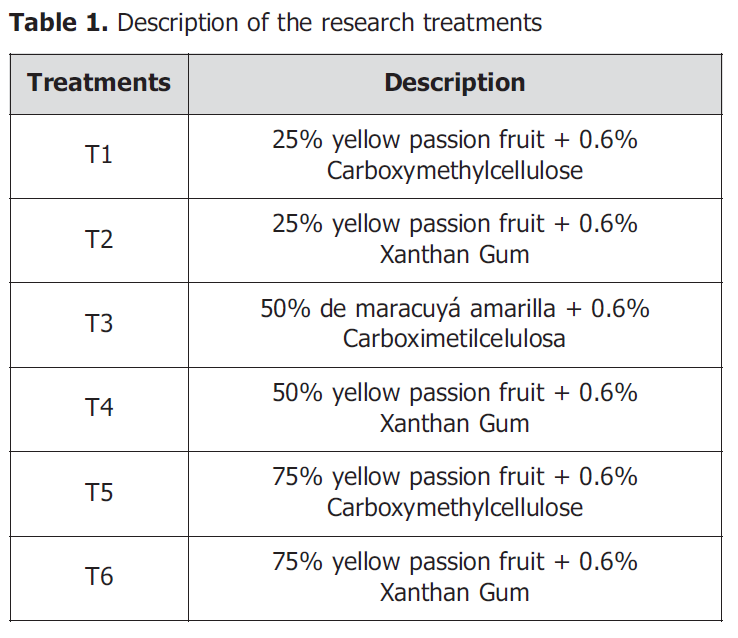
A completely randomized design with an A*B factorial arrangement was used, where factor A corresponds to the different concentrations of passion fruit and factor B to the hydrocolloids used. A total of 6 treatments with 3 replicates were obtained. To determine significant differences between the treatment means, a Tukey multiple range test (p<0.05) was used with the InfoStat statistical software. The treatment arrangements are shown in Table 1.
Experimental management
Preparation for jam: To prepare the passion fruit pulp, a longitudinal cut was made to extract the pulp. Sugar was then added, and the mixture was left to ferment for 3 hours. It was then cooked over medium heat for 35 minutes to obtain syrup. Next, the hydrocolloids, as shown in Table 1, were added, and the mixture was cooked over low heat for 15 minutes. The product was packaged in 180g glass jars that had been previously sterilized. The jars were then pasteurized at 95°C for 10 minutes to inactivate pathogens and create a vacuum seal. Finally, the product was stored under refrigeration at 4°C.
Experimental measurements
pH determination: This was performed on the product (jam) according to the Ecuadorian standard “NTE INEN 377. Fruit Preserves.” A 10 ml sample was taken, and the reading was obtained directly using a pH PCE-228 M meter13.
Titratable acidity determination:This was determined based on the predominant acid, which in the case of passion fruit pulp is citric acid, following the Ecuadorian standard “NTE INEN-ISO 750:2013. Vegetable and Fruit Products. Determination of Titratable Acidity”14.
°Brix determination: This was determined according to the standard “NTE INEN 380. Vegetable Preserves. Determination of Soluble Solids.” Two drops of the sample were placed on a Zuzi HPD008 refractometer15.
Ash determination: Ash content was determined following the established AOAC (2000) methodology. Twenty grams of each sample were placed in a muffle furnace (Pinzuar) at a temperature of 500°C16. Ash content was then calculated using the following equation:

Pf: Final weight of the crucible (calcined sample) in grams
Pi: Initial weight of the empty crucible in grams
Pm: Weight of the sample in grams
Viscosity determination: Viscosity was determined by direct reading using a viscometer (ROTAVISC). A 15 g sample was used for analysis, in accordance with the Mexican standard NOM-F-151-S-1981, regarding consistency determination.
Sensory characterization: For sensory evaluation, a panel of 11 untrained judges was organized, using a 5-point hedonic scale. The following categories were determined: color, flavor, aroma, consistency, and acceptability.
Microbiological Analysis: It was developed in accordance with the aerobic mesophilic standard, molds and yeasts NTE INEN 1529-10 (1998) regarding the microbiological control of food17.
RESULTS
Bromatological determinations
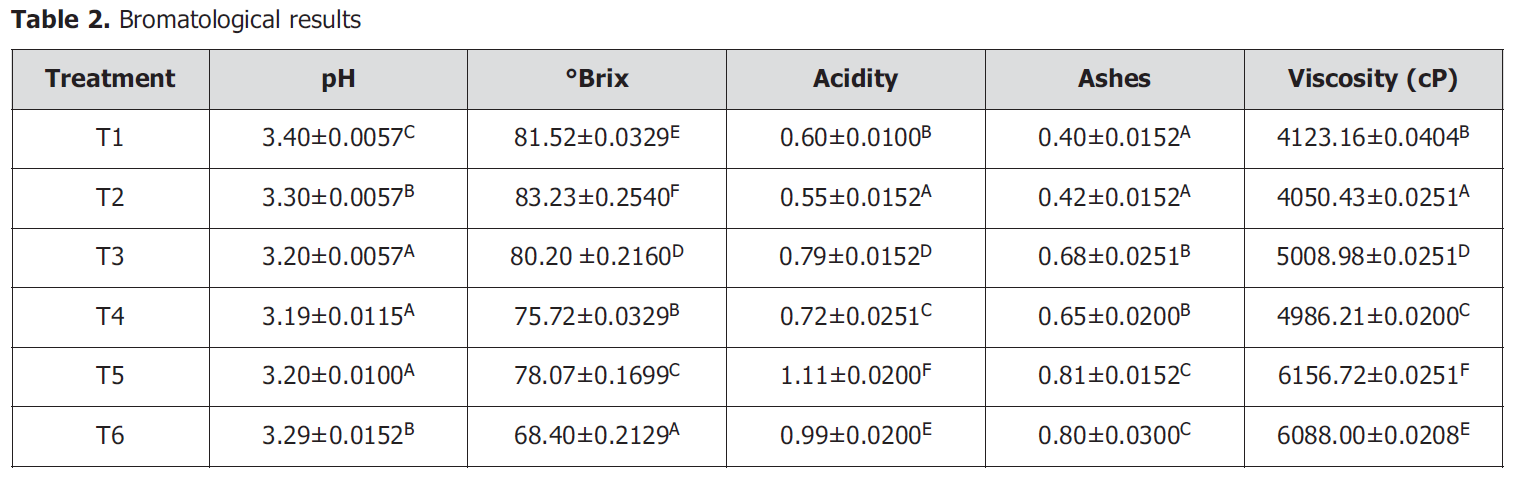
Regarding the pH content of the samples, a significant difference (p<0.05) was observed between the means of the treatments, with the highest incidence occurring in T1 (25% yellow passion fruit + Carboxymethylcellulose), while the lowest pH value was obtained in treatments 3, 4, and 5. This indicates that a higher quantity of raw material (passion fruit) decreases the pH value.
As observed in the °Brix samples, there was a significant difference (p<0.05), with the superior effect observed in T2 (25% yellow passion fruit + Xanthan Gum) at 83.23% compared to T6 (75% yellow passion fruit + Xanthan Gum) at 68.40%. This variability is closely related to the percentage of raw material used in the jam formulation as well as the amount of sugar used.
The acidity of the jam showed a significant difference (p<0.05), with the highest value in T5 (75% yellow passion fruit + 0.6% carboxymethylcellulose) at 1.11%, followed by T6 (75% yellow passion fruit + xanthan gum) at 0.99%. According to the analysis, the increased acidity values were due to the considerable concentration of passion fruit pulp and the different hydrocolloids used in the various treatments.
Statistically significant differences (p<0.05) were found in the studied factors and interactions. Notably, treatment T5 (75% yellow passion fruit + 0.6% carboxymethylcellulose) yielded a considerable percentage of ash in the jam, averaging 0.81%, compared to T1 (25% yellow passion fruit + 0.6% carboxymethylcellulose), which had a low percentage of 0.40%. In fact, the ash analysis showed an increase in ash content as the concentration of added raw material increased in the different treatments.
As with the previous parameters, the analysis of variance determined significant differences (p<0.05). T5 (75% yellow passion fruit + 0.6% Carboxymethylcellulose) was categorized with higher viscosity values (6156.72 cP) and T2 (25% yellow passion fruit + Xanthan Gum) registered lower values (4050.43 cP) than the average.
Determination of sensory categories
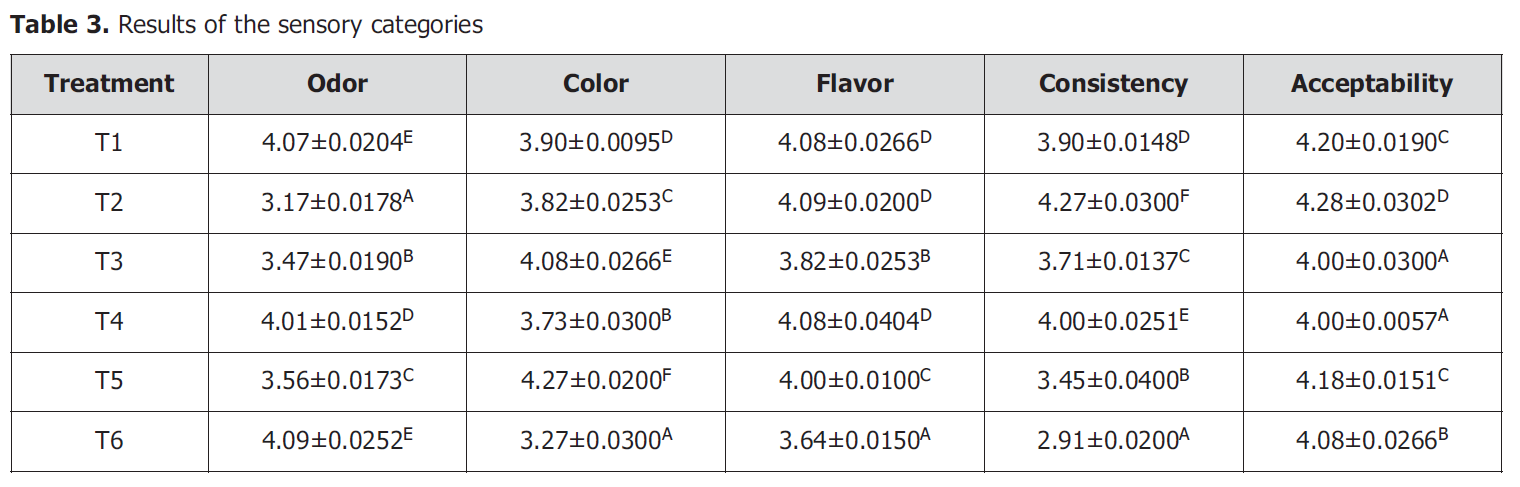
Regarding sensory characterization (Table 3), it was observed that T1 (25% yellow passion fruit + 0.6% carboxymethylcellulose) and T6 (75% yellow passion fruit + 0.6% xanthan gum) exhibited the highest intensity in the aroma category, with scores of 4.07 and 4.09, respectively. On the other hand, T2 (25% yellow passion fruit + 0.6% xanthan gum) received the highest scores for flavor (4.08), consistency (4.27), and acceptability (4.28). In terms of color, the samples containing xanthan gum presented a light yellowish hue, unlike those containing the CMC hydrocolloid, which resulted in a darker color. Thus, the tasters reported that T5 (75% yellow passion fruit + 0.6% carboxymethylcellulose), with a score of 4.27, obtained the best rating in this category.
Microbiological analysis
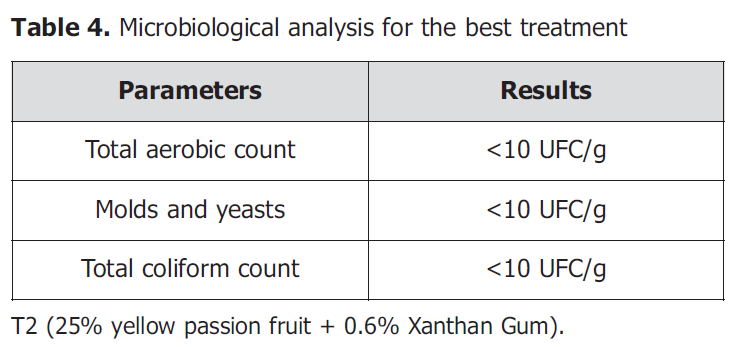
Once the best treatment, T2 (25% yellow passion fruit + 0.6% xanthan gum), was identified as shown in Table 4 a microbiological analysis was performed, comparing it to the requirements established in INEN Standard 419, which sets a maximum requirement of 30 CFU/g for mold and yeast counts. The analysis found that the results were within the standard’s parameters. In other words, no mold or yeast was detected in the chosen treatment. It should be noted that the jam-making process includes heat treatment, which could have inhibited (though this has not been proven) the growth of these microorganisms.
DISCUSSION
Bromatological determinations
Several authors have determined pH values of 3.20 in jam juice prior to the preparation of yellow passion fruit jam18. These results were also lower than those reported by Novelina et al. (2020), who determined values of 3.12 to 5.52 in passion fruit jellies.
According to the FAO, jams, jellies, syrups, sweets, and preserves contain approximately 65 °Brix10. Furthermore, it was also verified that the total soluble solids of the product should be in the range of 60–65% °Brix20.
Incidentally, the CONVENIN 2592-89 standard establishes a maximum acidity of 1% for jams. However, Colombian regulations (Resolution 003929, 2013, p. 29) establish a minimum acidity value of 0.5%, which, when compared with the results of this study, falls within the average of the analyses.
Subsequently, these ash values coincide with those recorded by Camayo et al., (2020), and are also within the permissible ranges, since a lower percentage of ash increases the nutritional quality of the product. Therefore, the ash data from22. In Honduras, which analyzed the ash content in Macambo almonds, is higher than the values found in the present study (4.33%).
Likewise, it was verified that the different thickeners (CMC, Xanthan Gum, and Pectin) increase the viscosity of the final product23. Furthermore, this response has also been demonstrated in previous studies such as24, which indicated that hydrocolloids affect product viscosity, indicating a rheological change in the product due to its isotropic structure.
Determination of sensory categories
Previous research has shown that the inclusion of hydrocolloids in the formation of passion fruit (Passiflora edulis Sims) chili sauce resulted in a product with improved consistency25. Similarly, the use of 0.5% pectin in prickly pear (Opuntia ficusindica) jam and sprouted quinoa (Chenopodium quinoa Willdenow) resulted in greater consumer acceptance26.
Microbiological analysis
Furthermore, according to Ruiz et al. (2019), the pH range found could prevent the proliferation of microorganisms. Based on the results, the final product is suitable for human consumption27.
CONCLUSION
The research determined that yellow passion fruit (Passiflora edulis Sims) has favorable physicochemical characteristics for use in jam making, resulting in significant organoleptic acceptability during processing and making it a suitable raw material for agro-industrial applications. Analysis of the bromatological factors according to the six treatments presented in Table 4 revealed the highest pH (3.40) in treatment T1, while T2 had the highest °Brix (83.23). Acidity (1.11), ash (0.81), and viscosity (6156.72) also showed higher values in treatment T5. Furthermore, the physicochemical and sensory properties of passion fruit jam were enhanced by the appropriate addition of hydrocolloids (CMC and xanthan gum). Finally, this research provides data for future investigations with other types of hydrocolloids, other concentrations of raw materials and different fruits, stimulating innovation in the production of jams and similar products.
REFERENCES
- Samyor, D, Chandra-Deka, S, Baram-Das, A. Physicochemical and phytochemical properties of foam mat dried passion fruit (Passiflora edulis Sims) powder and comparison with fruit pulp. J Food Sci Technol. 2021; 58(2), 787-796. doi:10.1007/s13197-020-04596-y
- Cesar, M, Beard, S, Otoboni, A, Quesada, K. J, Fiorini, A, Nicolau, C, Guiguier, E. Possible industrial applications of passion fruit oil. International Journal of Development Research. 2022 12(2). http://www.scielo.org.pe/scielo.php?script=sci_nlinks&pid=S2077-9917202300030033500016&lng=en
- Dubey, A, Kumar, A, Rao, P.S. Development and storage study of reduced calorie aloe vera (Aloe barbadensis Miller) based pineapple fruit jam. Journal of Food Measurement and Characterization. 2021; 15(1), 961–975. doi:10.1007/s11694-020-00689-6
- Haro, J, Fonseca, G. Zamora, P. Characterization and Typification of the Agro-productive Chain of the Passion Fruit (Passiflora edulis L) Crop in Pedernales, Manabí, Ecuador. KnE Engineering. 2020; 5(2), 697–716 doi:10.18502/keg.v5i2.6292
- Aiello, D, Fiorenza, A, Leonardi, G, Vitale, A, Polizzi, G. Fusarium nirenbergiae (Fusarium oxysporum Species Complex) Causing the Wilting of Passion Fruit in Italy. Plants, 2021; 10(10). doi:10.3390/plants10102011
- Biswas, S, Mishra, R, Bist, A. Passion to profession: a review of passion fruit processing. Aptisi Transactions on Technopreneurship. 2021; 3(1), 48-57. http://www.scielo.org.pe/scielo.php?script=sci_nlinks&pid=S2077-9917202300030033500009&lng=en
- Fonseca, A, Geraldí, M, Maróstica, M., Silvestre, A, Rocha, S. Purple passion fruit (Passiflora edulis f. edulis): A comprehensive review on the nutritional value, phytochemical profile and associated health effects. Food Research International. 2022; 160. doi:10.1016/j.foodres.2022.111665
- Palacios, D, Palacios, P, Sosa-León, J. Physicochemical, sensorial and microbiological evaluation of passion fruit jam (Passiflora edulisSims) and camote, Piura. Revista de Invest. Agropecuaria Science and Biotechnology. 2024; 04(01), 34-41. doi:10.25127/riagrop.20241.968
- Neha, P, Arora, P, Veer, P. Studies on sensory and physico-chemical assessment of health benefits of pineapple jam prepared with different levels of dark chocolate and aloe vera. Pharma Innovation J. 2019; 8(6), 1253–1259. doi:10.22271/tpi
- Food and Agriculture Organization [FAO]. Procesamiento a pequeña escala de frutas y hortalizas amazónicas nativas e introducidas. FAO. 1997. https://www.fao.org/4/x5029s/X5029S07.htm
- Giura, L, Urtasun, L, Belarra, A, Ansorena, D, Astiasarán, I. Exploring Tools for Designing DysphagiaFriendly Foods: A Review. Foods. 2021; 10(06). doi:10.3390/alimentos10061334
- Gregorova, A, Saha, N, Kitano, T, Saha, P. Hydrothermal effect and mechanical stress properties of carboxymethylcellulose based hydrogel Food Packag. Carbohydr Polym. 2015; 559–568. doi:10.1016/j.carbpol.2014.10.009.
- Ecuadorian Institute of Standardization [INEN]. (1988). Ecuadorian Technical Standard NTE INEN. Fruit Preserves. https://es.scribd.com/document/169800785/ec-nte-0377-1988
- Ecuadorian Institute of Standardization [INEN]. (2013). Ecuadorian Technical Standard NTE INEN ISO 750:2013. Vegetable and Fruit Products. Determination of Titratable Acidity.” https://www.studocu.com/ec/document/escuela-superior-politecnica-de-chimborazo/fitopatologia/norma-tecnica-ecuatorianante-inen-iso-7/99540173
- Ecuadorian Institute of Standardization [INEN]. (1985). Ecuadorian Technical Standard NTE INEN 380. Vegetable Preserves. Determination of Soluble Solids.https://es.scribd.com/document/363596001/380
- Association of Official Analytical Chemists. (2000). Association of Official Analytical Chemists. Determination Ash. https://es.scribd.com/document/349980253/AOAC-Methods
- Ecuadorian Institute of Standardization [INEN]. (2013). Ecuadorian Technical Standard NTE INEN 1529 - 10. https://es.scribd.com/document/488093112/1529-10-1R-MOHOS-Y-LEVADURAS-VIABLES-pdf
- Tadele, B, Abera, S, Dereje, B. Optimization of ingredients level for developing yellow passion (passiflora edulis) fruit jam. International Journal of Fruit Science. 2022; 22, 183-202. doi:10.1080/15538362.2022.2025515
- Novelina, R, Yenrina, R, Hidayat, R. The effect of addition passion fruit (Passiflora edulis. Sims) juice on characteristic of kolang - kaling jam. Int.J.Adv.Res. 2020; 8(1), 818-827. doi:10.21474/IJAR01/10369
- Natnicha, T, Kanyarat, L, Kraiyot, S. Effect of passion fruit juice and pectin on characteristics of Purple Yard Long Bean jam. IOP Conference Series: Materials Science and Engineering. 2019. 639. doi:0.1088/1757-899X/639/1/012049
- Camayo-Lapa, B.F, Quispe-Solano, M. Á, Cruz-Porta, E.A, Manyari-Cervantes, G. M, Espinoza-Silva, C.R, Cruz, A.R. Pumpkin (Cucurbita maxima Dutch.) compote for infants, functional, low cost, preservative-free and with a considerable shelf life: rheological, sensory, physicochemical, nutritional and microbiological characteristics. Scientia Agropecuaria. 2020; 11(2), 203-212. doi:10.26621/ra.v1i25.718
- Paradas-Vásquez, E, Lovo-L, Arias, A, Molina, M. Rescue de patashte (Theobroma bicolor Humb & Bonpl.) and cushta (Theobroma angustifolium), two promising species in danger of extinction in El Salvador. Minerva Magazine, 2019; 2(1), 109-122. doi:10.5377/revminerva.v2i1.12531
- Egoavil, J, Guadalupe, J. (2017). Effect of three types of thickeners on the rheological and sensory profile of aguaymato (Physalis peruviana L.) compote. Tarma. 2017. https://repositorio.uncp.edu.pe/bitstream/handle/20.500.12894/4774/Ego%c3%a1vil%20Pecho%20-
- Contreras-Lozano, K, Ciro-Velasquez, H, Marquez-Cardozo, C. Effect of the addition of hydrocolloids and aloe vera gel (Aloe barbadensis Miller) on the rheological properties of a beverage of sweet corn (Zea mays var. saccharata). DYNA. 2018; 85(204), 302-310. doi: 10.15446/dyna.v85n204.63205
- Szafrańska, J, Solowiej, B. Cheese sauces: Characteristics of ingredients, manufacturing methods,microbiological anda sensory aspects. Food Process Engineering. 2020; 43. doi:0.1111/jfpe.13364
- Cargua-Peñafiel, V, Castro-Nazate, K. Obtaining pectin from arazá (Eugenia stipitata) for application as a thickener in a prickly pear (Opuntia ficus-indica) jam. 2020; DSpace. http://repositorio.upec.edu.ec/handle/123456789/1318
- Ruiz-Ruiz, J. Evelopment of nopal-pineapple marmalade formulated with stevia aqueous extract: effect on physicochemical properties, inhibition of α-amylase, and glycemic response. Nutricion hospitalaria. 2019; 36(5). doi:10.26621/ra.v1i25.718
Explorar
Artículos
Volúmenes
Sobre la revista
Más leídos
Consumo de bebidas energizantes y efectos adversos en la salud de estudiantes universitarios
Nutrición Clínica y Dietética Hospitalaria
Uso de redes sociales y riesgo de trastornos de conducta alimentaria en adolescentes mujeres de un colegio en Lima, Perú
Nutrición Clínica y Dietética Hospitalaria
Consumo de bebidas energizantes en estudiantes universitarios y sus factores asociados.
Nutrición Clínica y Dietética Hospitalaria
Microbiota intestinal y eje intestino-cerebro: una revisión de su interacción con el sistema nervioso central
Nutrición Clínica y Dietética Hospitalaria
Factores asociados a la diabetes mellitus tipo 2 de la población adulta peruana.
Nutrición Clínica y Dietética Hospitalaria