Artículo original
Vol. 46 Núm. 1 (2026)
23 min
Relationships among dietary self-efficacy, healthy eating behavior and orthorexia nervosa ın young adults ın Turkey: a cross-sectional study
İrem Nur ŞAHİN ANILGAN
Istanbul Beykent University, Faculty of Health Sciences, Department of Nutrition and Dietetics, Istanbul, Turkey. Research Assistant.
*Correspondencia:
İrem Nur Şahi̇n Anilgan nursahin@beykent.edu.tr
Recepción:
03/02/2026
Aceptación:
14/03/2026
Publicación:
24/03/2026
Cómo citar
İrem Nur ŞAHİN ANILGAN. Relationships among dietary self-efficacy, healthy eating behavior and orthorexia nervosa ın young adults ın Turkey: a cross-sectional study. Nutr Clín Diet Hosp. 2026; 46(1):410-418 DOI: 10.12873/461insahin
Métricas
290
Visualizaciones
83
Descargas
Compartir
Compartir
Resumen (EN)
Background: Orthorexia nervosa (ON) represents a pathological obsession with healthy eating. While dietary self-efficacy and positive attitudes are generally considered beneficial for health, their relationship with the risk of developing obsessive eating patterns remains complex. This study aimed to investigate the relationships between dietary self-efficacy, healthy eating attitudes, and orthorexia nervosa among university students in Turkey.
Participants and Procedure: A cross-sectional study was conducted with 381 university students. Data were gathered between February and March 2024 through a structured questionnaire comprising a Sociodemographic Form, the Dieting Self-Efficacy Scale (DIET-SE), the Attitude Scale for Healthy Nutrition (ASHN), and the ORTO-11 Scale. Data were collected through voluntary sampling, where students were randomly invited to participate within the university campus. Statistical analyses were performed using SPSS v26.0, employing descriptive statistics, t-tests, Pearson correlation, and multiple linear regression to identify predictors of ON.
Results: Female students demonstrated significantly higher scores in DIET-SE (31.56 ± 8.65), ASHN (71.13 ± 10.82), and ORTO-11 (27.11 ± 4.51) compared to males (p < 0.05). Notably, the lower ORTO-11 scores in male students indicate a higher tendency toward orthorexia nervosa compared to females. BMI was negatively correlated with all scales (p < 0.05), suggesting that lower BMI is associated with higher ORTO-11 scores and thus lower orthorectic tendencies. Positive correlations were found between DIET-SE and both ASHN (r = 0.202, p < 0.001) and ORTO-11 (r = 0.129, p = 0.012). Multiple linear regression revealed that healthy eating attitudes were the strongest predictor of ON tendency (B = -0.088, p < 0.001), alongside age (B = -0.246, p = 0.028).
Conclusions: High dietary self-efficacy is linked to positive nutritional attitudes but may also increase the risk of orthorexia nervosa. These findings suggest that health interventions should focus on enhancing self-efficacy while simultaneously promoting dietary flexibility to prevent the transition from health-conscious eating to pathological obsession.
Palabras clave (EN):
body mass index
psychometrics
eating disorders
university population
Eating behavior
INTRODUCTION
The adoption of an adequate and balanced diet is a critical factor in fostering a healthy lifestyle. Poor dietary habits contribute to a decline in public health, leading to an increase in nutrition-related issues, including obesity, diabetes, and cardiovascular diseases1. The rising prevalence of diet-related disorders, coupled with heightened awareness of food contamination due to environmental threats such as toxins in soil, water, and air, has intensified interest in organic and healthfocused food options2. In response to these concerns, numerous governmental bodies and international organizations have implemented diverse programs aimed at promoting healthy living practices3.
Healthy eating strategies involve a multi-dimensional approach including the continuity of behavior, content selection, and portion control. However, when these strategies are driven by an obsessive focus on food purity, they may lead to Orthorexia Nervosa (ON)4.
ON is an eating disorder that is not yet included in psychiatric diagnostic classification systems such as Diagnostic and Statistical Manual of Mental Disorders, Fifth Edition (DSM-V) and International Classification of Diseases 11 (ICD-11). It is marked by an obsessive focus on healthy eating, which can gradually interfere with daily functioning, and often involves spending substantial time thinking about and planning healthy eating5. The concept was first introduced by Bratman in 1997, and several diagnostic criteria have since been proposed, although no consensus has been reached. These criteria generally focus on an obsessive preoccupation with food quality, strict avoidance of foods perceived as unhealthy, and resulting impairments in social, occupational, or other important areas of functioning. Individuals with ON often prioritize food quality over quantity, showing meticulous attention to ingredients, purchasing methods, preparation, cooking techniques, and even the equipment used6. They may experience intense guilt when consuming foods they consider unhealthy, and their daily activities and social relationships may be disrupted by the amount of time spent managing their diet7.
Beliefs about self-efficacy are crucial in determining individuals’ behaviors and motivations, impacting their capacity to take actions that enhance their lives8. Bandura describes selfefficacy as the confidence in one’s capability to organize and carry out the necessary actions to handle future situations9. Dietary self-efficacy emerged as a targeted framework to explore the link between self-efficacy and nutritional habits, offering insights into how confidence in making dietary choices can influence overall health outcomes.
Specifically, dietary self-efficacy refers to the confidence to maintain a healthy diet even in difficult situations, such as during stress or when exposed to unhealthy food options. It encompasses the ability to regulate eating behaviors, make nutritious choices, and achieve dietary goals, underscoring its role in promoting long-term healthy habits10,11. Studies show that higher self-efficacy is linked to healthier eating behaviors and lower body mass index (BMI). This suggests that individuals who are confident in their dietary control tend to make healthier choices and maintain a healthier weight12,13. While previous studies have focused on the psychological aspects of eating behaviors14, there is a lack of evidence exploring the specific intersection between dieting self-efficacy and orthorectic tendencies in the Turkish young adult population. This study hypothesizes that there is a significant relationship between dietary self-efficacy, healthy eating attitudes, and orthorexia nervosa tendencies among young adults. This study aims to bridge the gap in the literature by evaluating how dieting self-efficacy relates to healthy eating attitudes and whether these factors collectively predict orthorectic behaviors in the Turkish young adult population.
MATERIALS AND METHODS
The study population consisted of students enrolled at Istanbul Beykent University. A total of 381 participants were recruited using a voluntary response sampling method between February and March 2024. While students were randomly invited to participate within the university campus, the final sample consisted of those who voluntarily agreed to engage in the research. A post-hoc power analysis was performed using G*Power 3.1.9.7 software. With a sample size of 381, the study achieved a power of over 0.80 to detect a medium effect size at a significance level of α = 0.05, confirming the adequacy of the sample size for the regression model. Only those who volunteered and provided informed consent were included in the sample.
Ethical approval was obtained from the XXX University NonInterventional Clinical Research Ethics Committee (Protocol No: [E-45778635-050.99-139624], Date: [31.01.2024]). All participants provided informed consent before participating in the study, which was conducted in accordance with the Declaration of Helsinki.
Data were collected through face-to-face administration of a structured questionnaire, which included the General Information Form, Dieting Self-Efficacy Scale (DIET-SE), Attitude Scale for Healthy Nutrition (ASHN), and ORTO-11 Scale, to individuals who agreed to participate.
Inclusion criteria for participants were being over 18 years of age, having no perception or communication impairments, and demonstrating a willingness to participate. Conversely, individuals were excluded if they were under 18, had perception or communication difficulties, or did not express a willingness to engage in the research.
General Information Form: The General Information Form included 28 questions designed to gather demographic and lifestyle data from participants. These questions covered a wide range of topics, including age, gender, height, weight, marital status, educational level, disease status, physical activity, sleep duration, meal patterns, and eating habits.
Dieting Self-Efficacy Scale (DIET-SE): The Dieting Self-Efficacy Scale (DIET-SE), originally developed by Stich et al. (2009)15 and adapted into Turkish by Hamurcu et al. (2023), was used to assess individuals’ perceived self-efficacy in maintaining a diet. The scale consists of 11 items and three subscales: High-Calorie Tempting Foods (HCTF), Social and Intrinsic Factors (SIF), and Negative Emotional Events (NEE). Items are rated on a 5-point Likert scale ranging from 1 (“Not at all sure”) to 5 (“Very sure”), with total scores ranging from 11 to 55. Higher scores indicate greater dieting self-efficacy. In the present study, the scale demonstrated high internal consistency (Cronbach’s alpha = 0.90)16.
Attitude Scale for Healthy Nutrition (ASHN): The Attitude Scale for Healthy Nutrition (ASHN), developed by Tekkurşun Demir and Cicioğlu (2019), was employed to evaluate attitudes toward healthy eating. This 21-item scale comprises four sub-factors: Knowledge About Nutrition, Emotion Towards Nutrition, Positive Nutrition, and Poor Nutrition. The total score ranges from 21 to 105, with higher scores reflecting more favorable attitudes toward healthy nutrition. The internal consistency coefficients for the sub-factors in the original study ranged from 0.75 to 0.9017.
ORTO-11 Scale: The tendency toward orthorexia nervosa was assessed using the ORTO-11 scale, a refined version of the ORTO-15 originally developed by Donini et al.18, The Turkish adaptation and reliability study were conducted by Arusoğlu et al. in 200819. The scale consists of 11 items rated on a 4-point Likert-type system, where lower scores signify a higher tendency toward orthorexia nervosa. For this study, the Cronbach’s alpha coefficient was reported as 0.62, which is consistent with the acceptable levels identified in the literature.
Statistical Analysis
Data analysis was conducted using IBM SPSS Statistics version 26.0 (IBM Corp., Armonk, NY, USA). Descriptive statistics, including frequency, percentage, mean (M), and standard deviation (SD), were calculated to summarize the data. The normality of the data was assessed using skewness and kurtosis values, with values between -1.5 and +1.5 considered acceptable for parametric tests. Various statistical techniques were employed to assess the relationships between demographic variables and scale scores.
The independent sample t-test was utilized to analyze gender-based differences in scale scores, while Pearson correlation analysis was applied to investigate correlations between age, BMI, and the study scale scores. Additionally, ANOVA was performed to evaluate differences among groups. Furthermore, a multiple linear regression analysis was performed to evaluate the predictive effects of dietary self-efficacy, healthy eating attitudes, age, body mass index (BMI), and gender on the ORTO-11 total score. The assumptions for multiple linear regression were tested; no multicollinearity issues were identified, as evidenced by Variance Inflation Factor (VIF) values below 5 and tolerance values above 0.1. To ensure the validity of the model, the Durbin-Watson statistic was calculated to verify the independence of errors, and homoscedasticity was confirmed through the examination of standardized residual plots. The regression model included all predictors simultaneously. A p-value of less than 0.05 (p < 0.05) was considered statistically significant for all analyses.
RESULTS
Sociodemographic Characteristics
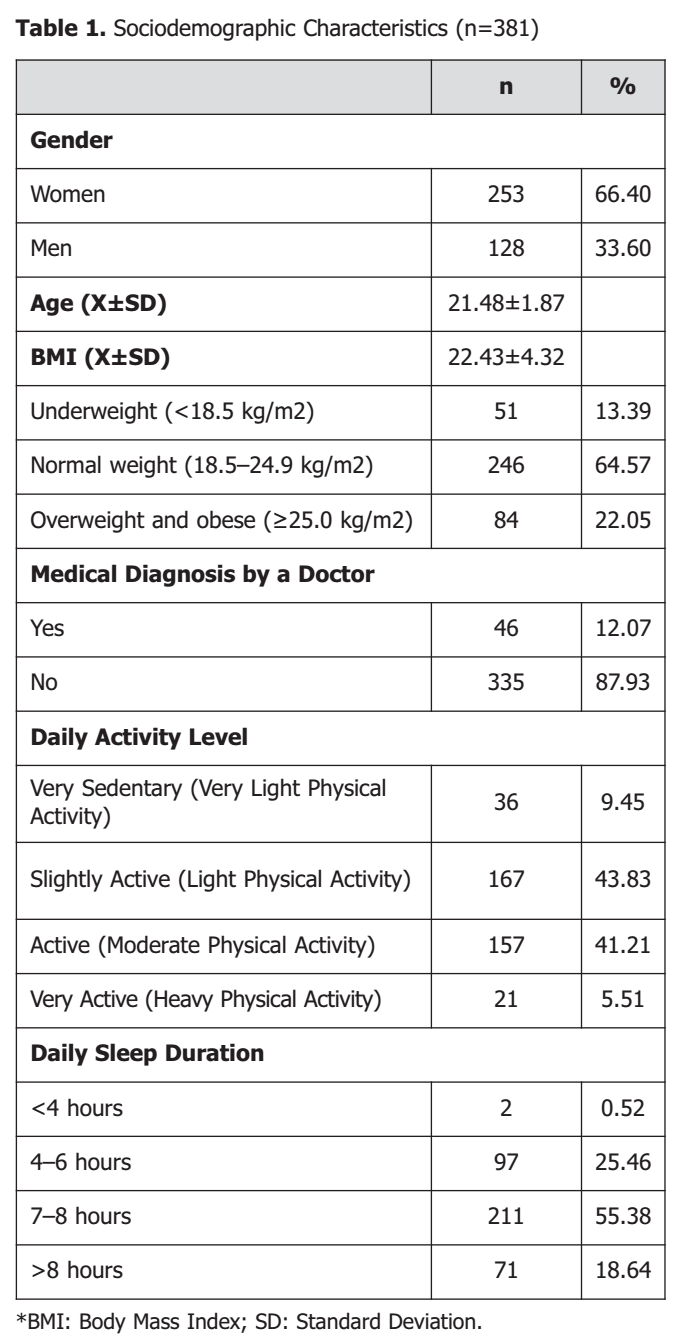
In this study, data from 381 university students were analyzed. Table 1 presents the demographic characteristics of the participants. Among the participants, 66.40% were women, and 33.60% were men. The mean age of the participants was 21.48 ± 1.87 years, and the average BMI was 22.43 ± 4.32 kg/m². According to BMI categories, 64.57% of the participants were classified as having a normal weight. It was found that 12.07% of the participants had a medical diagnosis from a health professional. Regarding physical activity levels, 43.83% of the participants engaged in light physical activity, while 41.21% engaged in moderate physical activity. In terms of sleep duration, 55.38% of the participants reported sleeping 7-8 hours per night, and 18.64% reported sleeping more than 8 hours.
Dietary Self-Efficacy, Healthy Eating Behavior, and Orthorexia Nervosa Scores
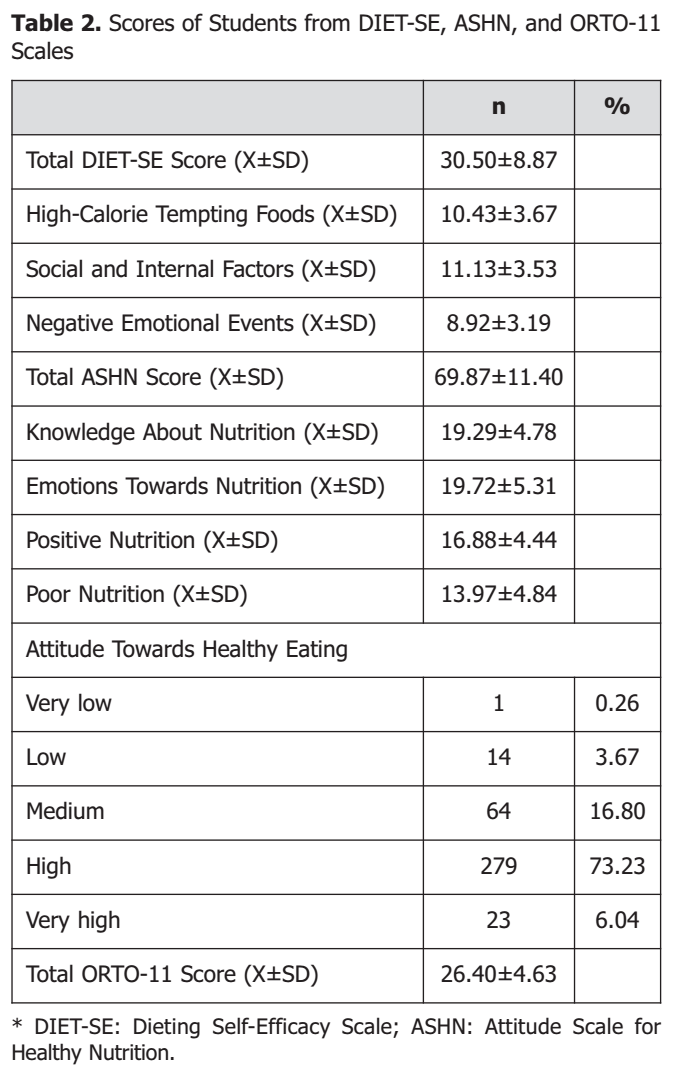
The participants’ mean total DIET-SE score was 30.50 ± 8.87. Among the DIET-SE subscales, the highest mean score was observed in Social and Internal Factors 11.13 ± 3.53), followed by High-Calorie Tempting Foods (10.43 ± 3.67) and Negative Emotional Events (8.92 ± 3.19). Regarding attitudes toward healthy eating, 73.23% of participants demonstrated a high attitude, while only 3.67% reported a low attitude 0.26%. The total ORTO-11 score of the participants was 26.40 ± 4.63. The distribution of participants’ scores for dietary self-efficacy, healthy eating attitudes, and orthorexia nervosa is presented in Table 2.
Evaluation of Scale Scores by Demographic Characteristics
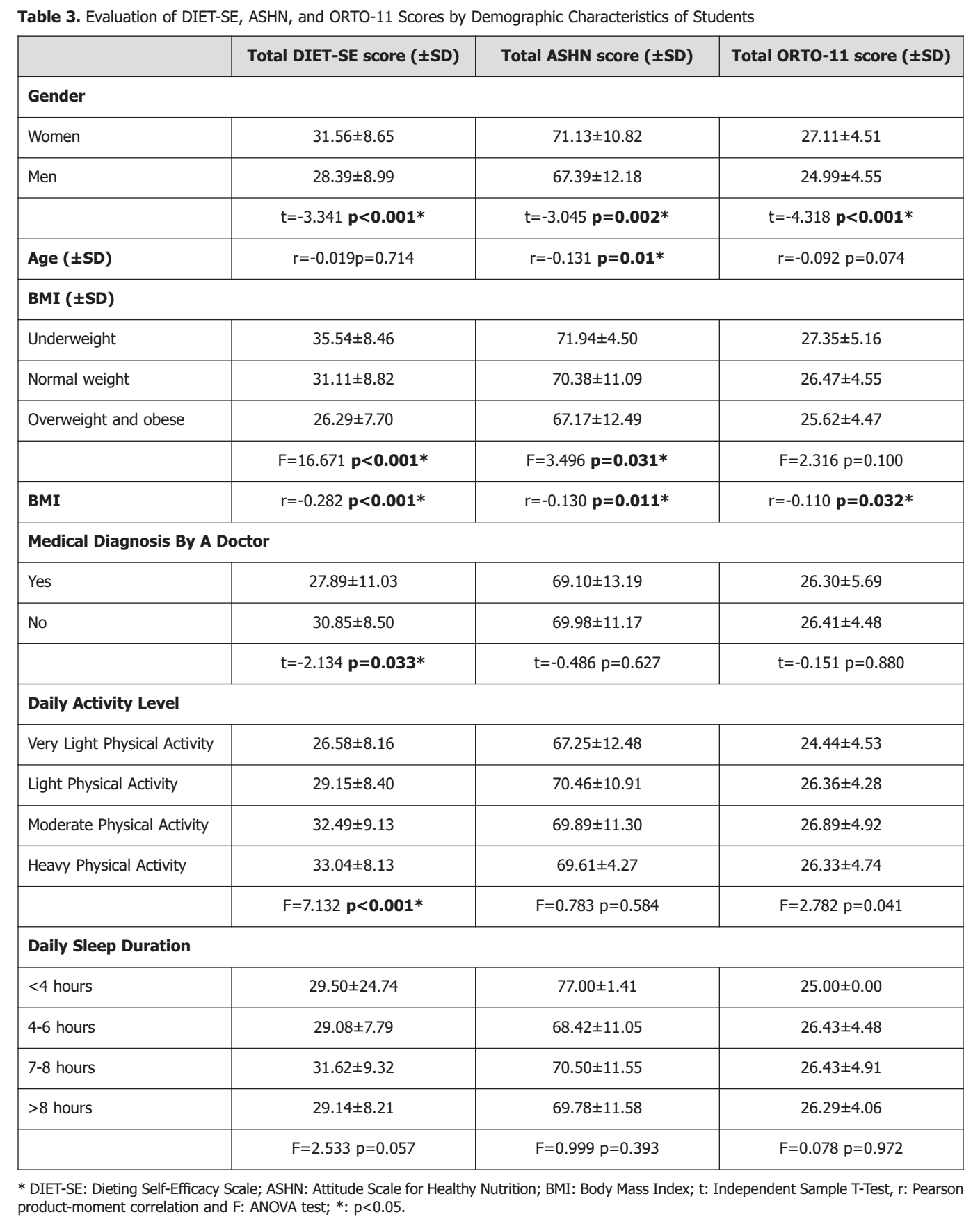
Statistically significant gender differences were observed across all primary scales. Female students scored significantly higher than male students on the DIET-SE (31.56 ± 8.65 vs. 28.39 ± 8.99, p < 0.001), ASHN (71.13 ± 10.82 vs. 67.39 ± 12.18, p = 0.002), and ORTO-11 (27.11 ± 4.51 vs. 24.99 ± 4.55, p < 0.001). Considering that lower ORTO-11 scores indicate a higher predisposition to orthorexia nervosa, these results suggest that male students in this sample exhibit a greater tendency toward orthorectic behaviors than female students.
A significant negative correlation was identified between BMI and all total scale scores, indicating that as BMI increased, DIET-SE (r = -0.282, p < 0.001), ASHN (r = -0.130, p = 0.011), and ORTO-11 (r = -0.110, p = 0.032) scores decreased, indicating that participants with higher BMI values demonstrated a greater tendency toward orthorexia nervosa. Furthermore, participants with a medical diagnosis had significantly lower DIET-SE scores compared to those without a diagnosis (27.89 ± 11.03 vs. 30.85 ± 8.50, p = 0.033). The evaluation of DIET-SE, ASHN, and ORTO-11 scores by demographic characteristics of students is presented in Table 3.
Correlation and Regression Analyses
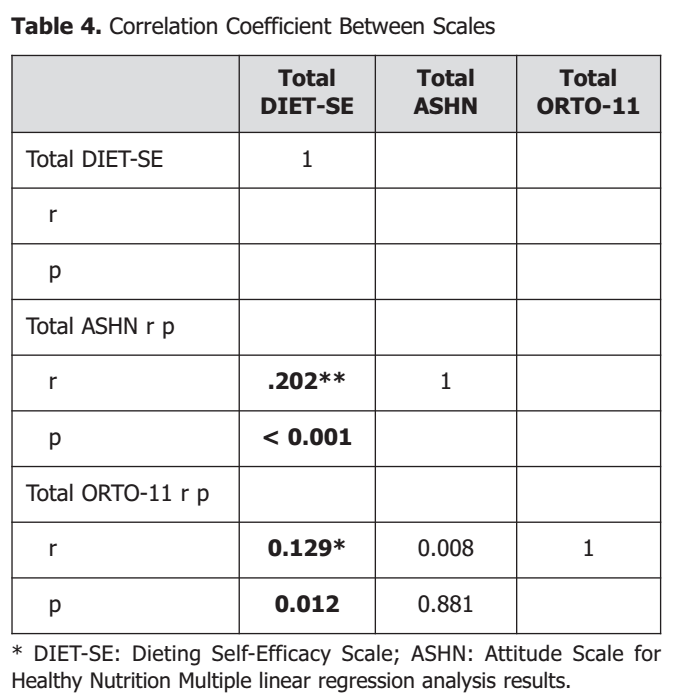
Pearson correlation analysis revealed significant positive weak correlations between students’ total DIET-SE scores and both total ASHN scores (r = 0.202, p < 0.001) and total ORTO-11 scores (r = 0.129, p = 0.012). This positive relationship suggests that as dietary self-efficacy increases, ORTO-11 scores also increase, which corresponds to a decrease in orthorectic tendencies. The correlation coefficients between dietary self-efficacy, healthy eating attitudes, and orthorexia nervosa scores are presented in Table 4.
Multiple linear regression analysis results
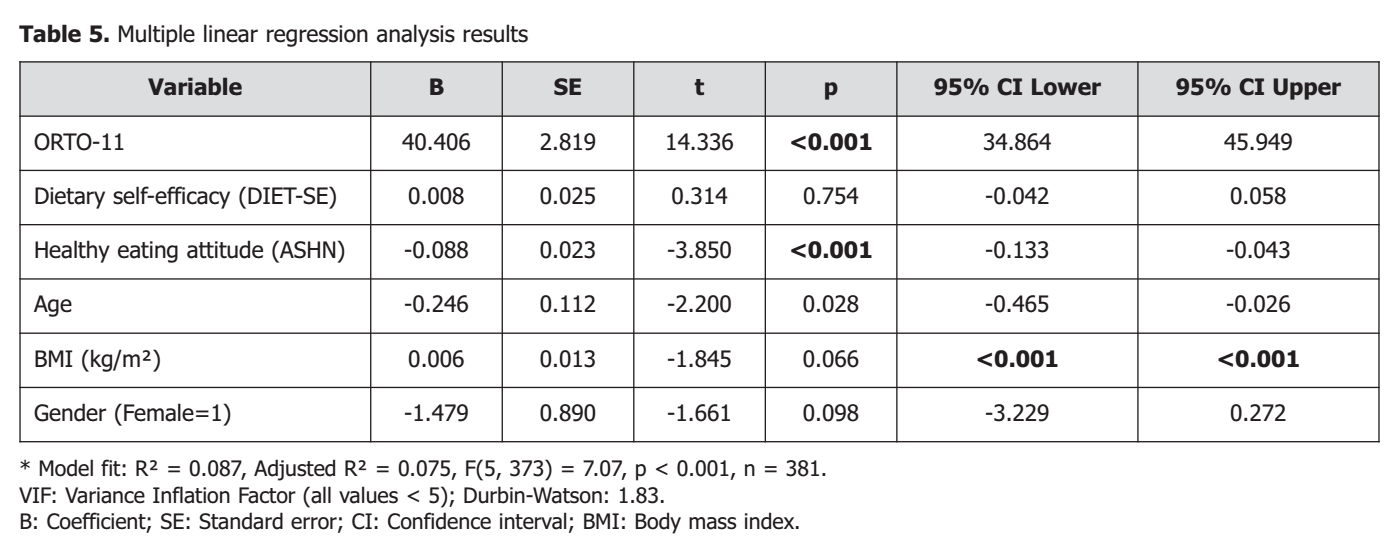
Multiple linear regression analysis was performed to predict orthorexia nervosa tendencies. Although the overall regression model was statistically significant (F(5, 373) = 7.07, p < 0.001), it explained only 7.5% of the variance in ORTO-11 scores. This indicates that while the identified predictors are meaningful, they provide a limited explanation of the factors influencing orthorexia nervosa in this population. Healthy eating attitudes (ASHN) were the strongest significant predictor of ORTO-11 scores (B = -0.088, p < 0.001), followed by age (B = -0.246, p = 0.028). The negative direction of this relationship indicates that as positive attitudes toward healthy eating increase, ORTO-11 scores decrease, thereby significantly increasing the severity of orthorexia nervosa tendencies. In this adjusted model, dietary self-efficacy, BMI, and gender were not found to be significant independent predictors of orthorexia tendencies (p > 0.05) Dietary self-efficacy was not a significant predictor in the adjusted model (p = 0.754). Assumptions for linear regression were met, with VIF values ranging between 1.01 and 1.22, indicating no multicollinearity issues. Additionally, the Durbin-Watson statistic was 1.83, confir ming the independence of residuals. The regression coefficients and related statistics are presented in Table 5.
DISCUSSION
Understanding the relationship between dietary self-efficacy, healthy eating behavior, and orthorexia nervosa among university students is crucial, as it can help enhance young adults’ eating habits and overall well-being. This study aimed to explore this relationship and identified a positive correlation between dietary self-efficacy and both healthy eating attitudes and orthorexia nervosa.
The demographic profile of the participants, with a predominance of women (66.40%), highlights gender as a significant factor influencing eating behaviors. The findings indicated that female participants had significantly higher scores on the DIET-SE, ASHN, and ORTO-11 scales compared to male participants.
The existing literature offers mixed results concerning gender differences in dietary self-efficacy. For example, one study involving adolescents found that girls had significantly higher dietary self-efficacy than boys. Conversely, a different study conducted among university students reported no significant gender differences in dietary self-efficacy10,20. Interestingly, a study focusing on students in sports sciences faculties showed a contrasting result, where male students had significantly higher ASHN scores than female students (p ≤ 0.05). These discrepancies highlight the influence of specific study populations and contexts on dietary self-efficacy and healthy eating behaviors. This discrepancy may be attributed to the fact that students enrolled in sports sciences faculties are predominantly male and generally possess greater knowledge and awareness regarding nutrition. This specific context could contribute to higher Attitude Scale for Healthy Nutrition (ASHN) scores among male students in this group. Supporting this notion, another study found no significant gender-based difference in total scale scores (p > 0.05)21. When examining the relationship between ORTO-11 scores and gender, the findings of this study align with previous research. Consistent with our results, earlier studies demonstrated that women tend to have higher ORTO-11 scores than men, with statistically significant differences observed22,23. Considering that lower ORTO-11 scores indicate a greater tendency toward orthorexia nervosa, our results suggest that male participants in this sample exhibit higher orthorectic tendencies than females. These variations may stem from the distinct demographic and cultural characteristics of the study populations. Nevertheless, the existing literature generally indicates that women exhibit greater awareness and sensitivity toward healthy eating, which may explain their higher scores on measures of dietary self-efficacy and orthorexia nervosa tendencies.
The average age of the participants was 21.48 ± 1.87 years, representing the young adult demographic. A negative correlation was observed between age and ASHN scores, indicating that healthy eating attitudes tend to decline as age increases. The higher healthy eating attitudes in the younger age group may be attributed to greater health consciousness and increased exposure to health-related information through social media. In contrast to our findings, one study reported a positive and statistically significant relationship between age and total ASHN scores, while other studies did not identify any significant differences21,24. No significant correlation was found between age and the total scores of DIET-SE and ORTO-11 in our study. These results highlight that healthy eating attitudes may vary with age and underscore the importance of tailored nutrition education for different age groups.
Findings related to BMI show that individuals with lower BMI levels have higher DIET-SE, ASHN, and ORTO-11 scores. These results reveal the significant impact of BMI on dietary self-efficacy and healthy eating attitudes. Considering the inverse scoring of the ORTO-11, where higher scores indicate lower risk, our findings suggest that individuals with lower BMI levels actually demonstrate lower orthorectic tendencies compared to those with higher BMI. Similarly, studies support that participants with low dietary self-efficacy have higher average BMI25–27. Studies comparing BMI and total ASHN scores mostly did not find a statistically significant difference between these two variables (p > 0.05)21,28–30. It is expected that individuals with high attitudes toward healthy eating have a more normal BMI due to the type and amount of food choices. Based on the negative relationship between ORTO-11 scores and BMI in our study, it can be concluded that as BMI increases, ORTO-11 scores decrease, suggesting that individuals in the overweight or obese categories may be more prone to ON in this specific population.
While 12.07% of the participants had a medical diagnosis by a doctor, this group’s DIET-SE scores were significantly lower compared to those without a diagnosis. This finding indicates that individuals with poor health conditions have lower confidence in their diet. Analyses based on physical activity levels showed that those engaging in very light physical activity had significantly lower DIET-SE scores compared to other groups, highlighting the positive impact of physical activity on dietary self-efficacy.
Significant positive correlations between DIET-SE scores and ASHN and ORTO-11 scores suggest that individuals with higher dietary self-efficacy also have higher healthy eating attitudes and a lower tendency towards orthorexia nervosa. Contrary to our initial interpretation, these findings suggest that an individual’s confidence in dieting may promote healthy eating habits while acting as a protective factor against the development of orthorexic obsessions, as indicated by higher ORTO-11 scores. This finding suggests that individuals’ confidence in dieting may increase healthy eating habits and the risk of orthorexia nervosa. It has been observed that those with high diet self-efficacy exhibit more restrictive and disordered eating behaviors, while those with low diet self-efficacy exhibit binge eating and bulimic behaviors31. These findings suggest that interventions aimed at increasing diet self-efficacy may reduce BMI by reducing binge eating and bulimic behaviors. A study conducted by Senécal and Nouwen demonstrated that dietary self-efficacy is a strong predictor of diet adherence and compliance among diabetes patients32. onsistent with these findings, self-efficacy is widely regarded as a critical factor in promoting engagement in healthy eating habits33. Dietary self-efficacy levels can be enhanced through various approaches, including behavior change techniques, stress management, self-monitoring of behaviors, evaluating behavioral rewards, providing performance feedback, and implementing conditional rewards34. The findings of the multiple regression analysis indicate that healthy eating attitudes were the strongest predictor of orthorexia nervosa tendencies among the variables examined. The negative association between healthy eating attitudes and ORTO-11 scores suggests that as individuals report more positive attitudes toward healthy eating, their orthorexia tendencies increase, consistent with the interpretation of lower ORTO-11 scores as higher ON severity. This aligns with previous research indicating that an intensified focus on healthy food choices may contribute to maladaptive eating behaviors when such attitudes become excessive or rigid. Age was also negatively associated with ON tendencies, indicating that younger individuals may be more vulnerable to developing obsessive patterns around healthy eating. Contrary to expectations, dietary self-efficacy was not a significant predictor when other variables were controlled for. It is important to note that our model explained a relatively low proportion of the variance (Adjusted R² = 0.075). This suggests that the model may be underspecified and that other psychological factors not included in this study such as perfectionism, anxiety, or the internalization of body ideals may play a more substantial role in predicting orthorectic behaviors. The marginal associations of BMI and gender warrant further investigation, as these factors may interact with cultural, social, and psychological influences on eating behavior. These results underscore the importance of distinguishing between adaptive healthy eating attitudes and maladaptive patterns that may evolve into orthorexic behaviors.
The positive correlation observed between orthorexia nervosa tendencies and dietary self-efficacy raises an important question: can the pursuit of healthy living itself become an obsession? While self-efficacy is generally considered a protective factor that facilitates healthier behaviors, in the context of orthorexia, higher confidence in one’s ability to adhere to strict dietary rules may actually reinforce rigid and perfectionistic eating patterns. This suggests that self-efficacy, when coupled with excessive concern for food purity, may contribute to maladaptive outcomes. Therefore, future studies should explore the boundary between adaptive confidence in healthy eating and the obsessive behaviors characteristic of orthorexia nervosa.
CONCLUSIONS
This study highlights the complex relationship between healthy eating attitudes, dietary self-efficacy, and orthorexic tendencies among university students. The primary finding indicates that while healthy eating attitudes are essential for nutritional well-being, they represent the strongest predictor of orthorexia nervosa when they transition into obsessive patterns. Our results demonstrate that lower ORTO-11 scores reflecting higher orthorectic risk are significantly associated with more positive attitudes towards healthy eating and lower age, suggesting that younger individuals with high health consciousness may be more vulnerable to maladaptive eating behaviors. Furthermore, higher dietary self-efficacy was found to be a protective factor, correlating with lower orthorectic tendencies.
Although the regression model explained a modest portion of the variance, the significance of gender and healthy eating attitudes underscores the need for targeted nutritional counseling. Professionals should distinguish between adaptive healthy eating and the rigid, obsessive patterns of orthorexia to promote sustainable health behaviors. Future research incorporating additional psychological dimensions such as perfectionism and anxiety is warranted to provide a more comprehensive framework for understanding the etiology of orthorexia nervosa in this population.
Strengths and limits
This study has several limitations. Firstly, its cross-sectional design limits the ability to establish causal relationships between dietary self-efficacy, healthy eating behavior, and orthorexia nervosa. Secondly, the study sample was not representative of the broader adult population in Turkey, which may restrict the generalizability of the findings. Thirdly, anthropometric data, including height and weight, were obtained through self-reported measures, which may introduce information bias. This reliance on self-reporting is a relevant methodological limitation that should be considered when interpreting BMI-related outcomes. Fourthly, other valuable anthropometric indicators such as waist circumference, fat mass, and lean mass-important for understanding fat tissue distribution-were not included in the study. Additionally, the Cronbach’s alpha for the ORTO-11 scale was 0.62. While this is within the acceptable range reported in the literature, its moderate reliability implies that the associations found between orthorexia and other variables should be interpreted with caution.
Despite these limitations, the study also has notable strengths. A key advantage is the use of validated and reliable scales specifically adapted to the Turkish population to assess dietary self-efficacy, healthy eating attitudes, and orthorexia nervosa. This rigorous methodological approach contributed to generating realistic and consistent results, thereby enhancing the study’s overall reliability and validity.
Data Availability Statement
The data that support the findings of this study are available from the corresponding author if requested.
REFERENCES
- Bazzano LA. The high cost of not consuming fruits and vegetables. J Am Diet Assoc. 2006;106(9):1364-8. doi: 10.1016/j.jada.2006.06.021
- Vos MB, Kaar JL, Welsh JA, Van Horn LV, Feig DI, Anderson CAM, et al. Added sugars and cardiovascular disease risk in children: a scientific statement from the American Heart Association. Circulation. 2017;135(19):e1017-34. doi: 10.1161/CIR.0000000000000439
- Kalyoncu Atasoy Z, Aslan D, Şeniz I, Merdol T. Evaluation of nutrition plans, programs and policies in Turkey from past to present and recommendations for the future. Beslenme ve Diyet Dergisi. 2021;49(3):112-23. doi: 10.33076/2021.BDD.1422
- Requero B, Paredes B, Gandarillas B, Moreno L. Promoting healthy eating by enhancing the correspondence between attitudes and behavioral intentions. Psicothema. 2020;32(1):47-53. doi: 10.7334/psicothema2019.222
- Bratman S, Knight D. Health food junkies: Orthorexia nervosa: Overcoming the obsession with healthful eating. New York: Broadway Books; 2004.
- McComb SE, Mills JS. Orthorexia nervosa: A review of psychosocial risk factors. Appetite. 2019;140:164-75. doi: 10.1016/j.appet.2019.05.005
- Turner PG, Lefevre CE. Instagram use is linked to increased symptoms of orthorexia nervosa. Eat Weight Disord. 2017;22(2): 277-84. doi: 10.1007/s40519-017-0364-2
- Arseven A. Self-efficacy: A concept analysis. Electronic Turkish Studies. 2016;11(10):63-80. doi: 10.7827/TurkishStudies.9665
- Bandura A. Self-efficacy: Toward a unifying theory of behavioral change. Psychol Rev. 1977;84(2):191-215. doi: 10.1037/0033-295X.84.2.191
- Nastaskin RS, Fiocco AJ. A survey of diet self-efficacy and food intake in students with high and low perceived stress. Nutr J. 2015;14:42. doi: 10.1186/s12937-015-0026-6
- Dzielska A, Mazur J, Nałęcz H, Oblacińska A, Fijałkowska A. Importance of self-efficacy in eating behavior and physical activity change of overweight and non-overweight adolescent girls participating in “Healthy Me”: A lifestyle intervention. Nutrients. 2020;12(6):1630. doi: 10.3390/nu12061630
- Annesi JJ, Gorjala S. Relations of self-regulation and self-efficacy for exercise and eating and BMI change: A field investigation. Biopsychosoc Med. 2010;4:10. doi: 10.1186/1751-0759-4-10
- Aynehchi A, Saleh-Ghadimi S, Dehghan P. The association of self-efficacy and coping strategies with body mass index is mediated by eating behaviors and dietary intake among young females: A structural equation modeling. PLoS One. 2023;18(5):e0284411. doi: 10.1371/journal.pone.0284411
- Aray Y, Sağin HŞ, Erdoğan E. What shapes our eating behavior? Understanding role of attachment, hedonic hunger, dieting self-efficacy among university students. Nutrire. 2026;51:5. doi: 10.1186/s41110-025-00298-x
- Stich C, Knäuper B, Tint A. A scenario-based dieting self-efficacy scale: The DIET-SE. Assessment. 2009;16(1):16-30. doi: 10.1177/1073191108322000
- Hamurcu P, Şahin İN, Batar N, Çelik A. Validity and reliability study of the Turkish version of the dieting self-efficacy scale. Osmangazi Tıp Dergisi. 2023;45(1):151-60. doi: 10.20515/otd.1130635
- Demir GT, Cicioğlu Hİ. Healthy eating attitude scale (HEAS): A validity and reliability study. Gaziantep Üniversitesi Spor Bilimleri Dergisi. 2019;4(2):256-74. doi: 10.31680/gaunsbd.549221
- Donini LM, Marsili D, Graziani MP, Imbriale M, Cannella C. Orthorexia nervosa: Validation of a diagnosis questionnaire. Eat Weight Disord. 2005;10(2):e28-32. doi: 10.1007/BF03327537
- Arusoğlu G, Kabakçı E, Köksal G, Merdol TK. Orthorexia nervosa and the adaptation study of ORTO-11 into Turkish. Turk Psikiyatri Derg. 2008;19(3):283-91.
- Efthymiou V, Charmandari E, Vlachakis D, Tsitsika A, Pałasz A, Chrousos G, et al. Adolescent self-efficacy for diet and exercise following a school-based multicomponent lifestyle intervention. Nutrients. 2021;13(10):3550. doi: 10.3390/nu13103550
- Özenoğlu A, Gün B, Karadeniz B, Koç F, Bilgin V, Bembeyaz Z, et al. The relationship of nutritional literacy with attitudes towards healthy eating and body mass index in adults. Life Sciences. 2021;16(1):1-18. doi: 10.18678/tlss.834418
- Asil E, Yılmaz M, Ayyıldız F, Yalçın T. The effect of social media use on orthorexia nervosa: a sample from Turkey. Nutr Hosp. 2023; 40(2):373-81. doi: 10.20960/nh.04258
- Öztürk PÇ. Determination of orthorexia nervosa tendencies of nursing students. Avrasya Sağlık Bilimleri Dergisi. 2021;4(3):99-105. doi: 10.53424/avrasyasbd.853381
- Gülen Ö, Kumartaşlı M, Madak E, Sönmez HO, Pepe O. An investigation of the nutrition attitude of Taekwon-Do athletes in terms of various variables. The Online Journal of Recreation and Sports. 2021;10(3):44-55. doi: 10.22282/ojrs.939223
- Brady D. BMI in males and females: the role of emotional, external, restrained eating and dieting self-efficacy [Master’s thesis]. Dublin: Dublin Business School; 2014.
- Frazier LD, Vaccaro JA, Garcia S, Fallahazad N, Rathi K, Leslie Frazier AD, et al. Diet self-efficacy and physical self-concept of college students at risk for eating disorders. J Am Diet Assoc. 2015;115(9):A35. doi: 10.1016/j.jada.2015.06.126
- Ramirez Luque DB, Rocha Huaman NL, Calizaya-Milla YE, Calizaya-Milla SE, Ramos-Vera C, Saintila J. Body self-perception, dietary self-efficacy, and body mass index in young adults: A cross-sectional survey. Int J Gen Med. 2023;16:193-202. doi: 10.2147/IJGM.S394236
- Demirbaş AB, Kılıçaslan A, Altınsöz S, Aksakal HB, Alphan ME. Investigation of the relationship between healthy eating attitude, random blood glucose and anthropometric measurements in university students. Atlas Journal of Medicine. 2023;3(1):12-19. doi: 10.54995/atlas.2023.23
- Çiğdem A. Nutrition literacy levels, affecting factors and relationship with healthy eating attitude in Pamukkale University students [Master’s thesis]. Denizli: Pamukkale University; 2023.
- Karakuyu B. Evaluation of nutritional habits and lifestyle changes of a group of medical faculty students during the Covid-19 pandemic process [Specialization thesis]. Isparta: Suleyman Demirel University; 2023.
- Saunders JF, Frazier LD, Nichols-Lopez KA. Self-esteem, diet self-efficacy, body mass index, and eating disorders: modeling effects in an ethnically diverse sample. Eat Weight Disord. 2016;21(3): 459-68. doi: 10.1007/s40519-015-0240-5
- Senécal C, Nouwen A, White D. Motivation and dietary self-care in adults with diabetes: Are self-efficacy and autonomous self-regulation complementary or competing constructs? Health Psychol. 2000;19(5):452-7. doi: 10.1037/0278-6133.19.5.452
- Leung VWL, Krumrei-Mancuso EJ, Trammell J. The effects of conflicting dietary information on dieting self-efficacy and motivation. Psi Chi Journal of Psychological Research. 2019;24(1): 54-65. doi: 10.24839/2325-7342.JN24.1.54
- Prestwich A, Kellar I, Parker R, MacRae S, Learmonth M, Sykes B, et al. How can self-efficacy be increased? Meta-analysis of dietary interventions. Health Psychol Rev. 2014;8(3):270-85. doi: 10.1080/17437199.2013.813729
Explorar
Artículos
Volúmenes
Sobre la revista
Más leídos
Consumo de bebidas energizantes y efectos adversos en la salud de estudiantes universitarios
Nutrición Clínica y Dietética Hospitalaria
Uso de redes sociales y riesgo de trastornos de conducta alimentaria en adolescentes mujeres de un colegio en Lima, Perú
Nutrición Clínica y Dietética Hospitalaria
Consumo de bebidas energizantes en estudiantes universitarios y sus factores asociados.
Nutrición Clínica y Dietética Hospitalaria
Microbiota intestinal y eje intestino-cerebro: una revisión de su interacción con el sistema nervioso central
Nutrición Clínica y Dietética Hospitalaria
Factores asociados a la diabetes mellitus tipo 2 de la población adulta peruana.
Nutrición Clínica y Dietética Hospitalaria